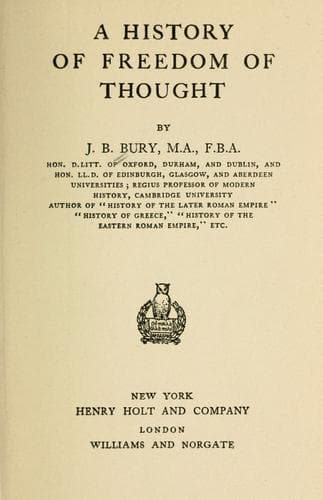
A History of Freedom of ThoughtBury, J. B. (John Bagnell)
Religion
A History of Freedom of Thought
Bury, J. B. (John Bagnell)
Free thought -- History; Rationalism -- History
The circumstances of the trial of Socrates illustrate both the tolerance
and the intolerance which prevailed at Athens. His long immunity, the
fact that he was at last indicted from political motives and perhaps
personal also, the large minority in his favour, all show that thought
was normally free, and that the mass of intolerance which existed was
only fitfully invoked, and perhaps most often to serve other purposes. I
may mention the case of the philosopher Aristotle, who some seventy
years later left Athens because he was menaced by a prosecution for
blasphemy, the charge being a pretext for attacking one who belonged to
a certain political party. The persecution of opinion was never
organized.
It may seem curious that to find the persecuting spirit in Greece we
have to turn to the philosophers. Plato, the most brilliant disciple of
Socrates, constructed in his later years an ideal State. In this State
he instituted
[36] a religion considerably different from the current religion, and
proposed to compel all the citizens to believe in his gods on pain of
death or imprisonment. All freedom of discussion was excluded under the
cast-iron system which he conceived. But the point of interest in his
attitude is that he did not care much whether a religion was true, but
only whether it was morally useful; he was prepared to promote morality
by edifying fables; and he condemned the popular mythology not because
it was false, but because it did not make for righteousness.
The outcome of the large freedom permitted at Athens was a series of
philosophies which had a common source in the conversations of Socrates.
Plato, Aristotle, the Stoics, the Epicureans, the Sceptics—it may be
maintained that the efforts of thought represented by these names have
had a deeper influence on the progress of man than any other continuous
intellectual movement, at least until the rise of modern science in a
new epoch of liberty.
The doctrines of the Epicureans, Stoics, and Sceptics all aimed at
securing peace and guidance for the individual soul. They were widely
propagated throughout the Greek world from the third century B.C., and
we may say that from this time onward most
[37] well-educated Greeks were more or less rationalists. The teaching
of Epicurus had a distinct anti-religious tendency. He considered fear
to be the fundamental motive of religion, and to free men’s minds from
this fear was a principal object of his teaching. He was a Materialist,
explaining the world by the atomic theory of Democritus and denying any
divine government of the universe. [2] He did indeed hold the existence
of gods, but, so far as men are concerned, his gods are as if they were
not—living in some remote abode and enjoying a “sacred and everlasting
calm.” They just served as an example of the realization of the ideal
Epicurean life.
Public-domain text, read in full here on John Shaqi.
Reviews
Reviews
No reviews yet
Be the first to share your thoughts on this work.
Join the Discussion
Join the discussion
Sign in to leave a comment or review.
Sign InorCreate an account