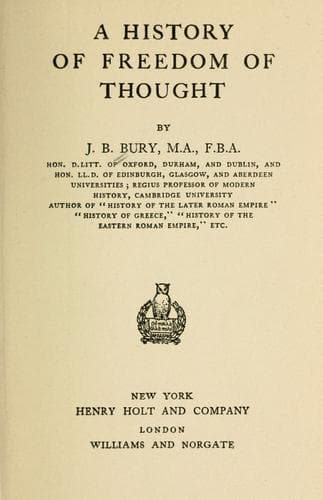
A History of Freedom of ThoughtBury, J. B. (John Bagnell)
Religion
A History of Freedom of Thought
Bury, J. B. (John Bagnell)
Free thought -- History; Rationalism -- History
[42] beyond the Israelites involve ultimately a danger to the Empire?
For its spirit was incompatible with the traditions and basis of Roman
society. The Emperor Domitian seems to have seen the question in this
light, and he took severe measures to hinder the proselytizing of Roman
citizens. Some of those whom he struck may have been Christians, but if
he was aware of the distinction, there was from his point of view no
difference. Christianity resembled Judaism, from which it sprang, in
intolerance and in hostility towards Roman society, but it differed by
the fact that it made many proselytes while Judaism made few.
Under Trajan we find that the principle has been laid down that to be a
Christian is an offence punishable by death. Henceforward Christianity
remained an illegal religion. But in practice the law was not applied
rigorously or logically. The Emperors desired, if possible, to extirpate
Christianity without shedding blood. Trajan laid down that Christians
were not to be sought out, that no anonymous charges were to be noticed,
and that an informer who failed to make good his charge should be liable
to be punished under the laws against calumny. Christians themselves
recognized that this edict practically protected them. There were
[43] some executions in the second century—not many that are well
attested—and Christians courted the pain and glory of martyrdom. There
is evidence to show that when they were arrested their escape was often
connived at. In general, the persecution of the Christians was rather
provoked by the populace than desired by the authorities. The populace
felt a horror of this mysterious Oriental sect which openly hated all
the gods and prayed for the destruction of the world. When floods,
famines, and especially fires occurred they were apt to be attributed to
the black magic of the Christians.
When any one was accused of Christianity, he was required, as a means of
testing the truth of the charge, to offer incense to the gods or to the
statues of deified Emperors. His compliance at once exonerated him. The
objection of the Christians—they and the Jews were the only objectors—to
the worship of the Emperors was, in the eyes of the Romans, one of the
most sinister signs that their religion was dangerous. The purpose of
this worship was to symbolize the unity and solidarity of an Empire
which embraced so many peoples of different beliefs and different gods;
its intention was political, to promote union and loyalty; and it is not
surprising that those who denounced it should
[44] be suspected of a disloyal spirit. But it must be noted that there
was no necessity for any citizen to take part in this worship. No
conformity was required from any inhabitants of the Empire who were not
serving the State as soldiers or civil functionaries. Thus the effect
was to debar Christians from military and official careers.
Public-domain text, read in full here on John Shaqi.
Reviews
Reviews
No reviews yet
Be the first to share your thoughts on this work.
Join the Discussion
Join the discussion
Sign in to leave a comment or review.
Sign InorCreate an account