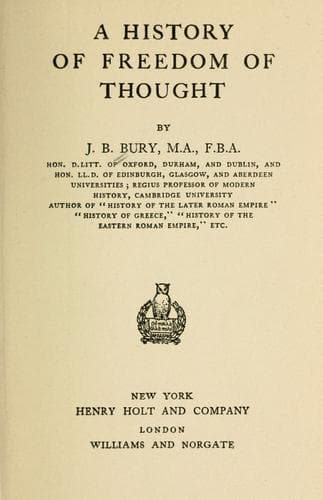
A History of Freedom of ThoughtBury, J. B. (John Bagnell)
Religion
A History of Freedom of Thought
Bury, J. B. (John Bagnell)
Free thought -- History; Rationalism -- History
The average brain is naturally lazy and tends to take the line of least
resistance. The mental world of the ordinary man consists of beliefs
which he has accepted without questioning and to which he is firmly
attached; he is instinctively hostile to anything which
[9] would upset the established order of this familiar world. A new
idea, inconsistent with some of the beliefs which he holds, means the
necessity of rearranging his mind; and this process is laborious,
requiring a painful expenditure of brain-energy. To him and his fellows,
who form the vast majority, new ideas, and opinions which cast doubt on
established beliefs and institutions, seem evil because they are
disagreeable.
The repugnance due to mere mental laziness is increased by a positive
feeling of fear. The conservative instinct hardens into the conservative
doctrine that the foundations of society are endangered by any
alterations in the structure. It is only recently that men have been
abandoning the belief that the welfare of a state depends on rigid
stability and on the preservation of its traditions and institutions
unchanged. Wherever that belief prevails, novel opinions are felt to be
dangerous as well as annoying, and any one who asks inconvenient
questions about the why and the wherefore of accepted principles is
considered a pestilent person.
The conservative instinct, and the conservative doctrine which is its
consequence, are strengthened by superstition. If the social structure,
including the whole body of customs and opinions, is associated
intimately
[10] with religious belief and is supposed to be under divine patronage,
criticism of the social order savours of impiety, while criticism of the
religious belief is a direct challenge to the wrath of supernatural
powers.
The psychological motives which produce a conservative spirit hostile to
new ideas are reinforced by the active opposition of certain powerful
sections of the community, such as a class, a caste, or a priesthood,
whose interests are bound up with the maintenance of the established
order and the ideas on which it rests.
Let us suppose, for instance, that a people believes that solar eclipses
are signs employed by their Deity for the special purpose of
communicating useful information to them, and that a clever man
discovers the true cause of eclipses. His compatriots in the first place
dislike his discovery because they find it very difficult to reconcile
with their other ideas; in the second place, it disturbs them, because
it upsets an arrangement which they consider highly advantageous to
their community; finally, it frightens them, as an offence to their
Divinity. The priests, one of whose functions is to interpret the divine
signs, are alarmed and enraged at a doctrine which menaces their power.
In prehistoric days, these motives, operating
Public-domain text, read in full here on John Shaqi.
Reviews
Reviews
No reviews yet
Be the first to share your thoughts on this work.
Join the Discussion
Join the discussion
Sign in to leave a comment or review.
Sign InorCreate an account