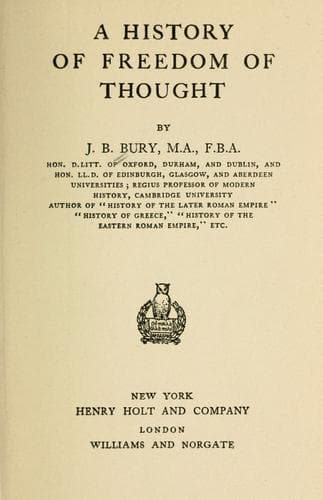
A History of Freedom of ThoughtBury, J. B. (John Bagnell)
Religion
A History of Freedom of Thought
Bury, J. B. (John Bagnell)
Free thought -- History; Rationalism -- History
“We were particularly desirous of reclaiming into the way of reason and
nature the deluded Christians, who had renounced the religion and
ceremonies instituted by their fathers and, presumptuously despising the
practice of antiquity, had invented extravagant laws and opinions
according to the dictates of their fancy, and had collected a various
society from the different provinces of our Empire. The edicts which we
have published to enforce the worship of the gods, having exposed many
of the Christians to danger and distress, many having suffered death and
many more, who still persist in their impious folly, being left
destitute of any public exercise of religion, we are disposed to extend
to those unhappy men the effects of our wonted clemency. We permit them,
therefore, freely to profess their private opinions, and to assemble in
their conventicles
[47] without fear or molestation, provided always that they preserve a
due respect to the established laws and government.” [5]
The second, of which Constantine was the author, known as the Edict of
Milan, was to a similar effect, and based toleration on the Emperor’s
care for the peace and happiness of his subjects and on the hope of
appeasing the Deity whose seat is in heaven.
The relations between the Roman government and the Christians raised the
general question of persecution and freedom of conscience. A State, with
an official religion, but perfectly tolerant of all creeds and cults,
finds that a society had arisen in its midst which is uncompromisingly
hostile to all creeds but its own and which, if it had the power, would
suppress all but its own. The government, in self-defence, decides to
check the dissemination of these subversive ideas and makes the
profession of that creed a crime, not on account of its particular
tenets, but on account of the social consequences of those tenets. The
members of the society cannot without violating their consciences and
incurring damnation abandon their exclusive doctrine. The principle of
freedom of conscience is asserted as superior to all obligations to the
State, and the State, confronted
[48] by this new claim, is unable to admit it. Persecution is the
result.
Public-domain text, read in full here on John Shaqi.
Reviews
Reviews
No reviews yet
Be the first to share your thoughts on this work.
Join the Discussion
Join the discussion
Sign in to leave a comment or review.
Sign InorCreate an account