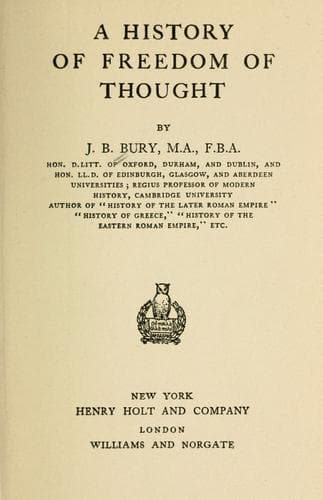
A History of Freedom of ThoughtBury, J. B. (John Bagnell)
Religion
A History of Freedom of Thought
Bury, J. B. (John Bagnell)
Free thought -- History; Rationalism -- History
[106] party has been moving towards the ultimate goal of complete
secularization and the separation of the Church from the State— the
logical results of Locke’s theory of civil government. The
Disestablishment of the Church in Ireland in 1869 partly realized this
ideal, and now more than forty years later the Liberal party is seeking
to apply the principle to Wales. It is highly characteristic of English
politics and English psychology that the change should be carried out in
this piecemeal fashion. In the other countries of the British Empire the
system of Separation prevails; there is no connection between the State
and any sect; no Church is anything more than a voluntary society. But
secularization has advanced under the State Church system. It is enough
to mention the Education Act of 1870 and the abolition of religious
tests at Universities (1871). Other gains for freedom will be noticed
when I come to speak in another chapter of the progress of rationalism.
If we compare the religious situation in France in the seventeenth with
that in the eighteenth century, it seems to be sharply contrasted with
the development in England. In England there was a great advance towards
religious liberty, in France there was a falling away. Until 1676 the
French Protestants
[107] (Huguenots) were tolerated; for the next hundred years they were
outlaws. But the toleration, which their charter (the Edict of Nantes,
1598) secured them, was of a limited kind. They were excluded, for
instance, from the army; they were excluded from Paris and other cities
and districts. And the liberty which they enjoyed was confined to them;
it was not granted to any other sect. The charter was faithfully
maintained by the two great Cardinals (Richelieu and Mazarin) who
governed France under Louis XIII and Louis XIV, but when the latter
assumed the active power in 1661 he began a series of laws against the
Protestants which culminated in the revoking of the charter (1676) and
the beginning of a Protestant persecution.
The French clergy justified this policy by the notorious text “Compel
them to come in,” and appealed to St. Augustine. Their arguments evoked
a defence of toleration by Bayle, a French Protestant who had taken
refuge in Holland. It was entitled a Philosophical Commentary on the
text “Compel them to come in” (1686) and in importance stands beside
Locke’s work which was being composed at the same time. Many of the
arguments urged by the two writers are identical. They agreed, and for
the same reasons, in excluding Roman Catholics. The
[108] most characteristic thing in Bayle’s treatise is his sceptical
argument that, even if it were a right principle to suppress error by
force, no truth is certain enough to justify us in applying the theory.
We shall see (next chapter) this eminent scholar’s contribution to
rationalism.
Public-domain text, read in full here on John Shaqi.
Reviews
Reviews
No reviews yet
Be the first to share your thoughts on this work.
Elsewhere in the archive
Join the Discussion
Join the discussion
Sign in to leave a comment or review.
Sign InorCreate an account