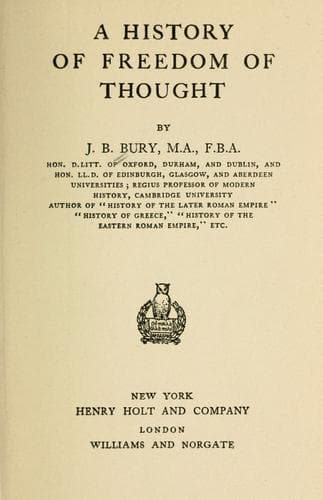
A History of Freedom of ThoughtBury, J. B. (John Bagnell)
Religion
A History of Freedom of Thought
Bury, J. B. (John Bagnell)
Free thought -- History; Rationalism -- History
Though there was an immense exodus of Protestants from France, Louis did
not succeed in his design of extirpating heresy from his lands. In the
eighteenth century, under Louis XV, the presence of Protestants was
tolerated though they were outlaws; their marriages were not recognized
as legal, and they were liable at any moment to persecution. About the
middle of the century a literary agitation began, conducted mainly by
rationalists, but finally supported by enlightened Catholics, to relieve
the affliction of the oppressed sect. It resulted at last in an Edict of
Toleration (1787), which made the position of the Protestants endurable,
though it excluded them from certain careers.
The most energetic and forceful leader in the campaign against
intolerance was Voltaire (see next chapter), and his exposure of some
glaring cases of unjust persecution did more than general arguments to
achieve the object. The most infamous case was that of Jean Calas, a
Protestant merchant of Toulouse, whose son committed suicide. A report
[109] was set abroad that the young man had decided to join the Catholic
Church, and that his father, mother, and brother, filled with Protestant
bigotry, killed him, with the help of a friend. They were all put in
irons, tried, and condemned, though there were no arguments for their
guilt, except the conjecture of bigotry. Jean Calas was broken on the
wheel, his son and daughter cast into convents, his wife left to starve.
Through the activity of Voltaire, then living near Geneva, the widow was
induced to go to Paris, where she was kindly received, and assisted by
eminent lawyers; a judicial inquiry was made; the Toulouse sentence was
reversed and the King granted pensions to those who had suffered. This
scandal could only have happened in the provinces, according to
Voltaire: “at Paris,” he says, “fanaticism, powerful though it may be,
is always controlled by reason.”
The case of Sirven, though it did not end tragically, was similar, and
the government of Toulouse was again responsible. He was accused of
having drowned his daughter in a well to hinder her from becoming a
Catholic, and was, with his wife, sentenced to death. Fortunately he and
his family had escaped to Switzerland, where they persuaded Voltaire of
their innocence. To get the sentence reversed was the work of nine
years, and this
[110] time it was reversed at Toulouse. When Voltaire visited Paris in
1778 he was acclaimed by crowds as the “defender of Calas and the
Sirvens.” His disinterested practical activity against persecution was
of far more value than the treatise on Toleration which he wrote in
connexion with the Calas episode. It is a poor work compared with those
of Locke and Bayle. The tolerance which he advocates is of a limited
kind; he would confine public offices and dignities to those who belong
to the State religion.
Public-domain text, read in full here on John Shaqi.
Reviews
Reviews
No reviews yet
Be the first to share your thoughts on this work.
Elsewhere in the archive
Join the Discussion
Join the discussion
Sign in to leave a comment or review.
Sign InorCreate an account