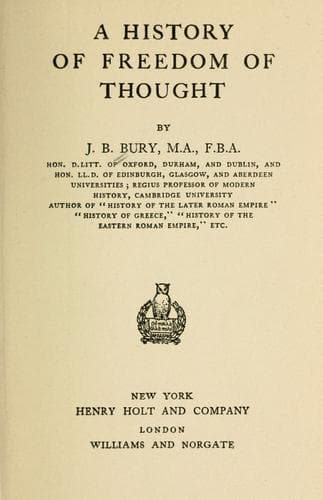
A History of Freedom of ThoughtBury, J. B. (John Bagnell)
Religion
A History of Freedom of Thought
Bury, J. B. (John Bagnell)
Free thought -- History; Rationalism -- History
A new rationalistic religion was introduced under the name of
Theophilanthropy. It was the “natural religion” of the philosophers and
poets of the century, of Voltaire and the English deists—not the
purified Christianity of Rousseau, but anterior and superior to
Christianity. Its doctrines, briefly formulated,
[115] were: God, immortality, fraternity, humanity; no attacks on other
religions, but respect and honour towards all; gatherings in a family,
or in a temple, to encourage one another to practise morality. Protected
by the government sometimes secretly, sometimes openly, it had a certain
success among the cultivated classes.
The idea of the lay State was popularized under this rule, and by the
end of the century there was virtually religious peace in France. Under
the Consulate (from 1799) the same system continued, but Napoleon ceased
to protect Theophilanthropy. In 1801, though there seems to have been
little discontent with the existing arrangement, Napoleon decided to
upset it and bring the Pope upon the scene. The Catholic religion, as
that of the majority, was again taken under the special protection of
the State, the salaries of the clergy again paid by the nation, and the
Papal authority over the Church again recognized within well-defined
limits; while full toleration of other religions was maintained. This
was the effect of the Concordat between the French Republic and the
Pope. It is the judgment of a high authority that the nation, if it had
been consulted, would have pronounced against the change. It may be
doubted whether this is true. But Napoleon’s policy
[116] seems to have been prompted by the calculation that, using the
Pope as an instrument, he could control the consciences of men, and more
easily carry out his plans of empire.
Apart from its ecclesiastical policies and its experiments in new creeds
based on the principles of rationalistic thinkers, the French Revolution
itself has an interest, in connexion with our subject, as an example of
the coercion of reason by an intolerant faith.
The leaders believed that, by applying certain principles, they could
regenerate France and show the world how the lasting happiness of
mankind can be secured. They acted in the name of reason, but their
principles were articles of faith, which were accepted just as blindly
and irrationally as the dogmas of any supernatural creed. One of these
dogmas was the false doctrine of Rousseau that man is a being who is
naturally good and loves justice and order. Another was the illusion
that all men are equal by nature. The puerile conviction prevailed that
legislation could completely blot out the past and radically transform
the character of a society. “Liberty, equality, and fraternity” was as
much a creed as the Creed of the Apostles; it hypnotized men’s minds
like a revelation from on high; and reason had as little part in its
propagation as in the spread
Public-domain text, read in full here on John Shaqi.
Reviews
Reviews
No reviews yet
Be the first to share your thoughts on this work.
Elsewhere in the archive
Join the Discussion
Join the discussion
Sign in to leave a comment or review.
Sign InorCreate an account