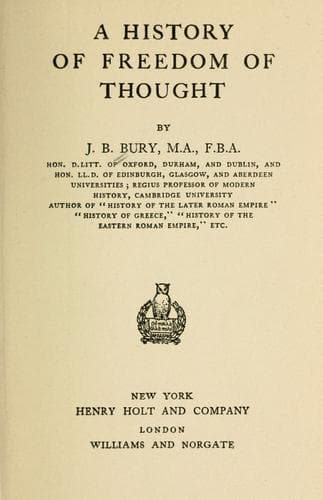
A History of Freedom of ThoughtBury, J. B. (John Bagnell)
Religion
A History of Freedom of Thought
Bury, J. B. (John Bagnell)
Free thought -- History; Rationalism -- History
The Revolution began well, but the spirit of Mirabeau was not in the
ascendant throughout its course. The vicissitudes in religious policy
from 1789 to 1801 have a particular interest, because they show that the
principle of liberty of conscience was far from possessing the minds of
the men who were proud of abolishing the intolerance of the government
which they had overthrown. The State Church was reorganized by the Civil
Constitution of the Clergy (1790), by which French citizens were
forbidden to acknowledge the authority of the Pope and
[113] the appointment of Bishops was transferred to the Electors of the
Departments, so that the commanding influence passed from the Crown to
the nation. Doctrine and worship were not touched. Under the democratic
Republic which succeeded the fall of the monarchy (1792–5) this
Constitution was maintained, but a movement to dechristianize France was
inaugurated, and the Commune of Paris ordered the churches of all
religions to be closed. The worship of Reason, with rites modelled on
the Catholic, was organized in Paris and the provinces. The government,
violently anti-Catholic, did not care to use force against the prevalent
faith; direct persecution would have weakened the national defence and
scandalized Europe. They naïvely hoped that the superstition would
disappear by degrees. Robespierre declared against the policy of
unchristianizing France, and when he had the power (April, 1795), he
established as a State religion the worship of the Supreme Being. “The
French people recognizes the existence of the Supreme Being and the
immortality of the Soul”; the liberty of other cults was maintained.
Thus, for a few months, Rousseau’s idea was more or less realized. It
meant intolerance. Atheism was regarded as a vice, and “all were
atheists who did not think like Robespierre.”
[114]
The democratic was succeeded by the middle-class Republic (1795–9), and
the policy of its government was to hinder the preponderance of any one
religious group; to hold the balance among all the creeds, but with a
certain partiality against the strongest, the Catholic, which
threatened, as was thought, to destroy the others or even the Republic.
The plan was to favour the growth of new rationalistic cults, and to
undermine revealed religion by a secular system of education.
Accordingly the Church was separated from the State by the Constitution
of 1795, which affirmed the liberty of all worship and withdrew from the
Catholic clergy the salaries which the State had hitherto paid. The
elementary schools were laicized. The Declaration of Rights, the
articles of the Constitution, and republican morality were taught
instead of religion. An enthusiast declared that “the religion of
Socrates, Marcus Aurelius, and Cicero would soon be the religion of the
world.”
Public-domain text, read in full here on John Shaqi.
Reviews
Reviews
No reviews yet
Be the first to share your thoughts on this work.
Elsewhere in the archive
Join the Discussion
Join the discussion
Sign in to leave a comment or review.
Sign InorCreate an account