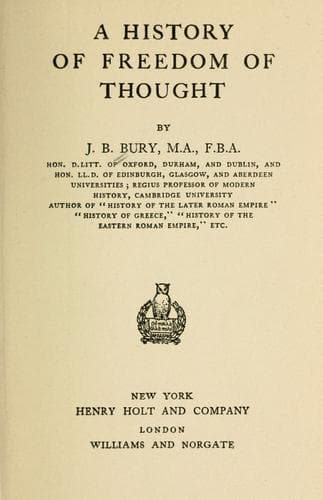
A History of Freedom of ThoughtBury, J. B. (John Bagnell)
Religion
A History of Freedom of Thought
Bury, J. B. (John Bagnell)
Free thought -- History; Rationalism -- History
Now people at all times have been commanded or expected or invited to
accept on authority alone—the authority, for instance, of public
opinion, or a Church, or a sacred book—doctrines which are not proved or
are not capable of proof. Most beliefs about nature and man, which were
not founded on scientific observation, have served directly or
indirectly religious and social interests, and hence they have been
protected by force against the criticisms of persons who have the
inconvenient habit of using their reason. Nobody minds if his neighbour
disbelieves a demonstrable fact. If a sceptic denies that Napoleon
existed, or that water is composed of oxygen and hydrogen, he causes
amusement or ridicule. But if he denies doctrines which cannot be
demonstrated, such as the existence of a personal God or the immortality
of the soul, he incurs serious disapprobation and at one time he might
have been put to death. Our mediaeval friend would have only been called
a fool if he doubted the existence of Constantinople, but if he had
questioned the significance of comets he
[18] might have got into trouble. It is possible that if he had been so
mad as to deny the existence of Jerusalem he would not have escaped with
ridicule, for Jerusalem is mentioned in the Bible.
In the Middle Ages a large field was covered by beliefs which authority
claimed to impose as true, and reason was warned off the ground. But
reason cannot recognize arbitrary prohibitions or barriers, without
being untrue to herself. The universe of experience is her province, and
as its parts are all linked together and interdependent, it is
impossible for her to recognize any territory on which she may not
tread, or to surrender any of her rights to an authority whose
credentials she has not examined and approved.
The uncompromising assertion by reason of her absolute rights throughout
the whole domain of thought is termed rationalism, and the slight stigma
which is still attached to the word reflects the bitterness of the
struggle between reason and the forces arrayed against her. The term is
limited to the field of theology, because it was in that field that the
self-assertion of reason was most violently and pertinaciously opposed.
In the same way free thought, the refusal of thought to be controlled by
any authority but its own, has a definitely theological reference.
Throughout
Public-domain text, read in full here on John Shaqi.
Reviews
Reviews
No reviews yet
Be the first to share your thoughts on this work.
Join the Discussion
Join the discussion
Sign in to leave a comment or review.
Sign InorCreate an account