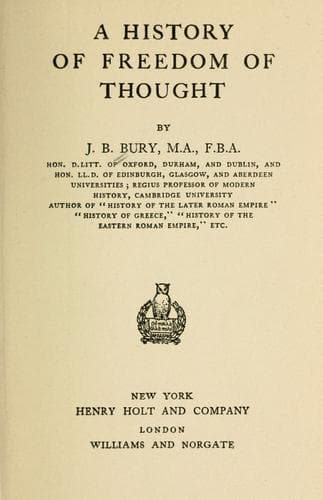
A History of Freedom of ThoughtBury, J. B. (John Bagnell)
Religion
A History of Freedom of Thought
Bury, J. B. (John Bagnell)
Free thought -- History; Rationalism -- History
If Locke’s philosophy, by setting authority in its place and deriving
all knowledge from experience, was a powerful aid to rationalism, his
contemporary Bayle worked in the same direction by the investigation of
history. Driven from France (see above, p. 107), he lived at Amsterdam,
where he published his Philosophical Dictionary. He was really a
freethinker, but he never dropped the disguise of orthodoxy, and this
lends a particular piquancy to his work. He takes a delight in
marshalling all the objections which heretics had made to essential
Christian dogmas. He exposed without mercy the crimes and brutalities of
David, and showed that this favourite of the Almighty was a person with
whom one would refuse to shake hands. There was a great outcry at this
unedifying candour. Bayle, in replying, adopted the attitude of
Montaigne and Pascal, and opposed faith to reason.
The theological virtue of faith, he said, consists in believing revealed
truths simply and solely on God’s authority. If you believe in the
immortality of the soul for
[136] philosophical reasons, you are orthodox, but you have no part in
faith. The merit of faith becomes greater, in proportion as the revealed
truth surpasses all the powers of our mind; the more incomprehensible
the truth and the more repugnant to reason, the greater is the sacrifice
we make in accepting it, the deeper our submission to God. Therefore a
merciless inventory of the objections which reason has to urge against
fundamental doctrines serves to exalt the merits of faith.
The Dictionary was also criticized for the justice done to the moral
excellencies of persons who denied the existence of God. Bayle replies
that if he had been able to find any atheistical thinkers who lived bad
lives, he would have been delighted to dwell on their vices, but he knew
of none such. As for the criminals you meet in history, whose abominable
actions make you tremble, their impieties and blasphemies prove they
believed in a Divinity. This is a natural consequence of the theological
doctrine that the Devil, who is incapable of atheism, is the instigator
of all the sins of men. For man’s wickedness must clearly resemble that
of the Devil and must therefore be joined to a belief in God’s
existence, since the Devil is not an atheist. And is it not a proof of
the infinite wisdom of God that the worst criminals
[137] are not atheists, and that most of the atheists whose names are
recorded have been honest men? By this arrangement Providence sets
bounds to the corruption of man; for if atheism and moral wickedness
were united in the same persons, the societies of earth would be exposed
to a fatal inundation of sin.
There was much more in the same vein; and the upshot was, under the thin
veil of serving faith, to show that the Christian dogmas were
essentially unreasonable.
Public-domain text, read in full here on John Shaqi.
Reviews
Reviews
No reviews yet
Be the first to share your thoughts on this work.
Elsewhere in the archive
Join the Discussion
Join the discussion
Sign in to leave a comment or review.
Sign InorCreate an account