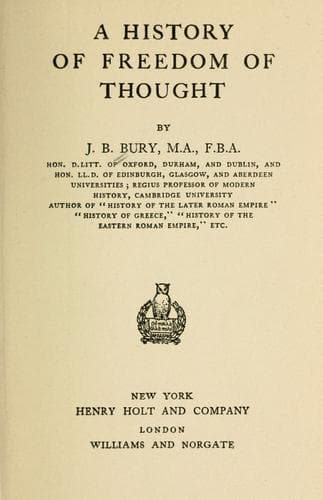
A History of Freedom of ThoughtBury, J. B. (John Bagnell)
Religion
A History of Freedom of Thought
Bury, J. B. (John Bagnell)
Free thought -- History; Rationalism -- History
Bayle’s work, marked by scholarship and extraordinary learning, had a
great influence in England as well as in France. It supplied weapons to
assailants of Christianity in both countries. At first the assault was
carried on with most vigour and ability by the English deists, who,
though their writings are little read now, did memorable work by their
polemic against the authority of revealed religion.
The controversy between the deists and their orthodox opponents turned
on the question whether the Deity of natural religion —the God whose
existence, as was thought, could be proved by reason—can be identified
with the author of the Christian revelation. To the deists this seemed
impossible. The nature of the alleged revelation seemed inconsistent
with the character
[138] of the God to whom reason pointed. The defenders of revelation, at
least all the most competent, agreed with the deists in making reason
supreme, and through this reliance on reason some of them fell into
heresies. Clarke, for instance, one of the ablest, was very unsound on
the dogma of the Trinity. It is also to be noticed that with both
sections the interest of morality was the principal motive. The orthodox
held that the revealed doctrine of future rewards and punishments is
necessary for morality; the deists, that morality depends on reason
alone, and that revelation contains a great deal that is repugnant to
moral ideals. Throughout the eighteenth century morality was the guiding
consideration with Anglican Churchmen, and religious emotion, finding no
satisfaction within the Church, was driven, as it were, outside, and
sought an outlet in the Methodism of Wesley and Whitefield.
Spinoza had laid down the principle that Scripture must be interpreted
like any other book (1670), [2] and with the deists this principle was
fundamental. In order to avoid persecution they generally veiled their
conclusions
Public-domain text, read in full here on John Shaqi.
Reviews
Reviews
No reviews yet
Be the first to share your thoughts on this work.
Elsewhere in the archive
Join the Discussion
Join the discussion
Sign in to leave a comment or review.
Sign InorCreate an account