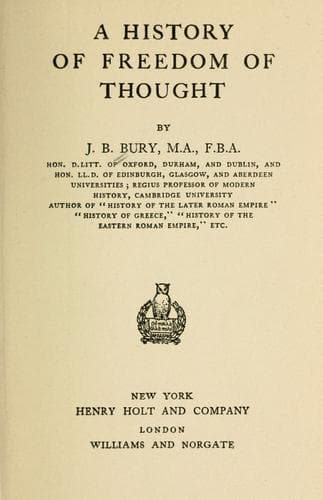
A History of Freedom of ThoughtBury, J. B. (John Bagnell)
Religion
A History of Freedom of Thought
Bury, J. B. (John Bagnell)
Free thought -- History; Rationalism -- History
The leading adversaries of the deists appealed, like them, to reason,
and, in appealing to reason, did much to undermine authority. The ablest
defence of the faith, Bishop Butler’s Analogy (1736), is suspected of
having raised more doubts than it appeased. This was the experience of
William Pitt the Younger, and the Analogy made James Mill (the
utilitarian) an unbeliever. The deists, argued that the unjust and cruel
God of Revelation could not be the God of nature; Butler pointed to
nature and said, There you behold cruelty and injustice. The argument
was perfectly good against the optimism of Shaftesbury, but it plainly
admitted of the conclusion—opposite to that which Butler wished to
establish—that a just and beneficent God does not exist. Butler is
driven to fall back on the sceptical argument that we are extremely
ignorant; that all things
[152] are possible, even eternal hell fire; and that therefore the safe
and prudent course is to accept the Christian doctrine. It may be
remarked that this reasoning, with a few modifications, could be used in
favour of other religions, at Mecca or at Timbuctoo. He has, in effect,
revived the argument used by Pascal that if there is one chance in any
very large number that Christianity is true, it is a man’s interest to
be a Christian; for, if it prove false, it will do him no harm to have
believed it; if it prove true, he will be infinitely the gainer. Butler
seeks indeed to show that the chances in favour amount to a probability,
but his argument is essentially of the same intellectual and moral value
as Pascal’s. It has been pointed out that it leads by an easy logical
step from the Anglican to the Roman Church. Catholics and Protestants
(as King Henry IV of France argued) agree that a Catholic may be saved;
the Catholics assert that a Protestant will be damned; therefore the
safe course is to embrace Catholicism. [3]
I have dwelt at some length upon some of the English deists, because,
while they occupy an important place in the history of
Public-domain text, read in full here on John Shaqi.
Reviews
Reviews
No reviews yet
Be the first to share your thoughts on this work.
Elsewhere in the archive
Join the Discussion
Join the discussion
Sign in to leave a comment or review.
Sign InorCreate an account