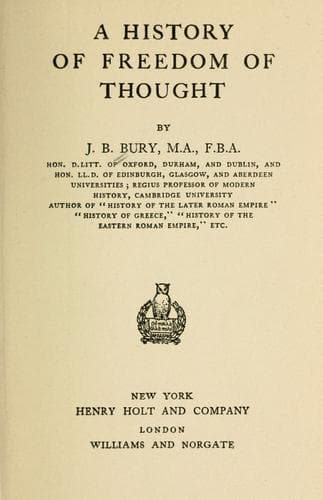
A History of Freedom of ThoughtBury, J. B. (John Bagnell)
Religion
A History of Freedom of Thought
Bury, J. B. (John Bagnell)
Free thought -- History; Rationalism -- History
[153] rationalism in England, they also supplied, along with Bayle, a
great deal of the thought which, manipulated by brilliant writers on the
other side of the Channel, captured the educated classes in France. We
are now in the age of Voltaire. He was a convinced deist. He considered
that the nature of the universe proved that it was made by a conscious
architect, he held that God was required in the interests of conduct,
and he ardently combated atheism. His great achievements were his
efficacious labour in the cause of toleration, and his systematic
warfare against superstitions. He was profoundly influenced by English
thinkers, especially Locke and Bolingbroke. This statesman had concealed
his infidelity during his lifetime except from his intimates; he had
lived long as an exile in France; and his rationalistic essays were
published (1754) after his death. Voltaire, whose literary genius
converted the work of the English thinkers into a world-force, did not
begin his campaign against Christianity till after the middle of the
century, when superstitious practices and religious persecutions were
becoming a scandal in his country. He assailed the Catholic Church in
every field with ridicule and satire. In a little work called The Tomb
of Fanaticism (written 1736,
[154] published 1767), he begins by observing that a man who accepts his
religion (as most people do) without examining it is like an ox which
allows itself to be harnessed, and proceeds to review the difficulties
in the Bible, the rise of Christianity, and the course of Church
history; from which he concludes that every sensible man should hold the
Christian sect in horror. “Men are blind to prefer an absurd and
sanguinary creed, supported by executioners and surrounded by fiery
faggots, a creed which can only be approved by those to whom it gives
power and riches, a particular creed only accepted in a small part of
the world—to a simple and universal religion.” In the Sermon of the
Fifty and the Questions of Zapata we can see what he owed to Bayle and
English critics, but his touch is lighter and his irony more telling.
His comment on geographical mistakes in the Old Testament is: “God was
evidently not strong in geography.” Having called attention to the
“horrible crime” of Lot’s wife in looking backward, and her conversion
into a pillar of salt, he hopes that the stories of Scripture will make
us better, if they do not make us more enlightened. One of his favourite
methods is to approach Christian doctrines as a person who had just
heard of the existence of Christians or Jews for the first time in his
life.
[155]
Public-domain text, read in full here on John Shaqi.
Reviews
Reviews
No reviews yet
Be the first to share your thoughts on this work.
Elsewhere in the archive
Join the Discussion
Join the discussion
Sign in to leave a comment or review.
Sign InorCreate an account