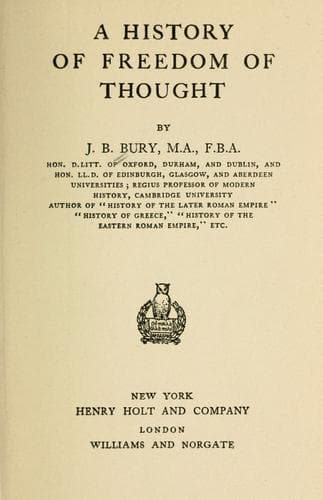
A History of Freedom of ThoughtBury, J. B. (John Bagnell)
Religion
A History of Freedom of Thought
Bury, J. B. (John Bagnell)
Free thought -- History; Rationalism -- History
[157] Rousseau, who contributed to the growth of freedom in a different
way. He was a deist, but his deism, unlike that of Voltaire, was
religious and emotional. He regarded Christianity with a sort of
reverent scepticism. But his thought was revolutionary and repugnant to
orthodoxy; it made against authority in every sphere; and it had an
enormous influence. The clergy perhaps dreaded his theories more than
the scoffs and negations of Voltaire. For some years he was a fugitive
on the face of the earth. Émile, his brilliant contribution to the
theory of education, appeared in 1762. It contains some remarkable pages
on religion, “the profession of faith of a Savoyard vicar,” in which the
author’s deistic faith is strongly affirmed and revelation and theology
rejected. The book was publicly burned in Paris and an order issued for
Rousseau’s arrest. Forced by his friends to flee, he was debarred from
returning to Geneva, for the government of that canton followed the
example of Paris. He sought refuge in the canton of Bern and was ordered
to quit. He then fled to the principality of Neufchâtel which belonged
to Prussia. Frederick the Great, the one really tolerant ruler of the
age, gave him protection, but he was persecuted and calumniated by the
local clergy, who but for Frederick would
[158] have expelled him, and he went to England for a few months (1766),
then returning to France, where he was left unmolested till his death.
The religious views of Rousseau are only a minor point in his heretical
speculations. It was by his daring social and political theories that he
set the world on fire. His Social Contract in which these theories were
set forth was burned at Geneva. Though his principles will not stand
criticism for a moment, and though his doctrine worked mischief by its
extraordinary power of turning men into fanatics, yet it contributed to
progress, by helping to discredit privilege and to establish the view
that the object of a State is to secure the wellbeing of all its
members.
Deism—whether in the semi-Christian form of Rousseau or the anti-
Christian form of Voltaire—was a house built on the sand, and thinkers
arose in France, England, and Germany to shatter its foundations. In
France, it proved to be only a half-way inn to atheism. In 1770, French
readers were startled by the appearance of Baron D’Holbach’s System of
Nature, in which God’s existence and the immortality of the soul were
denied and the world declared to be matter spontaneously moving.
Holbach was a friend of Diderot, who had also come to reject deism. All
the leading
Public-domain text, read in full here on John Shaqi.
Reviews
Reviews
No reviews yet
Be the first to share your thoughts on this work.
Elsewhere in the archive
Join the Discussion
Join the discussion
Sign in to leave a comment or review.
Sign InorCreate an account