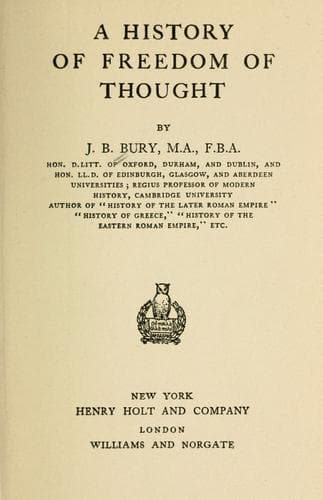
A History of Freedom of ThoughtBury, J. B. (John Bagnell)
Religion
A History of Freedom of Thought
Bury, J. B. (John Bagnell)
Free thought -- History; Rationalism -- History
His drama, Saul (1763), which the police tried to suppress, presents the
career of David, the man after God’s own heart, in all its naked horror.
The scene in which Samuel reproves Saul for not having slain Agag will
give an idea of the spirit of the piece. SAMUEL: God commands me to tell
you that he repents of having made you king. SAUL: God repents! Only
they who commit errors repent. His eternal wisdom cannot be unwise. God
cannot commit errors. SAMUEL: He can repent of having set on the throne
those who do. SAUL: Well, who does not? Tell me, what is my fault?
SAMUEL: You have pardoned a king. AGAG: What! Is the fairest of virtues
considered a crime in Judea? SAMUEL (to Agag): Silence! do not
blaspheme. (To Saul). Saul, formerly king of the Jews, did not God
command you by my mouth to destroy all the Amalekites, without sparing
women, or maidens, or children at the breast? AGAG: Your god—gave such a
command! You are mistaken, you meant to say, your devil. SAMUEL: Saul,
did you obey God? SAUL: I did not suppose such a command
[156] was positive. I thought that goodness was the first attribute of
the Supreme Being, and that a compassionate heart could not displease
him. SAMUEL: You are mistaken, unbeliever. God reproves you, your
sceptre will pass into other hands.
Perhaps no writer has ever roused more hatred in Christendom than
Voltaire. He was looked on as a sort of anti-Christ. That was natural;
his attacks were so tremendously effective at the time. But he has been
sometimes decried on the ground that he only demolished and made no
effort to build up where he had pulled down. This is a narrow complaint.
It might be replied that when a sewer is spreading plague in a town, we
cannot wait to remove it till we have a new system of drains, and it may
fairly be said that religion as practised in contemporary France was a
poisonous sewer. But the true answer is that knowledge, and therefore
civilization, are advanced by criticism and negation, as well as by
construction and positive discovery. When a man has the talent to attack
with effect falsehood, prejudice, and imposture, it is his duty, if
there are any social duties, to use it.
For constructive thinking we must go to the other great leader of French
thought,
Public-domain text, read in full here on John Shaqi.
Reviews
Reviews
No reviews yet
Be the first to share your thoughts on this work.
Elsewhere in the archive
Join the Discussion
Join the discussion
Sign in to leave a comment or review.
Sign InorCreate an account