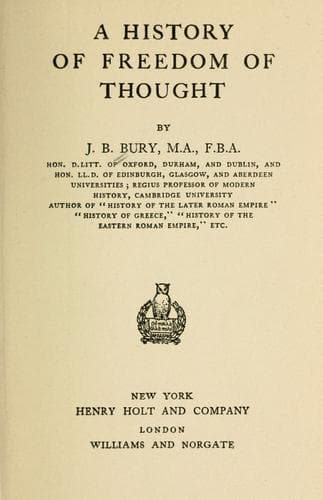
A History of Freedom of ThoughtBury, J. B. (John Bagnell)
Religion
A History of Freedom of Thought
Bury, J. B. (John Bagnell)
Free thought -- History; Rationalism -- History
[165] philosophers in a laborious work has recorded all the great
phenomena of nature, earthquakes, meteors, comets, and eclipses, which
his indefatigable curiosity could collect. Both the one and the other
have omitted to mention the greatest phenomenon to which the mortal eye
has been witness since the creation of the globe.” How “shall we excuse
the supine inattention of the pagan and philosophic world to those
evidences which were presented by the hand of Omnipotence, not to their
reason, but to their senses?”
Again, if every believer is convinced of the reality of miracles, every
reasonable man is convinced of their cessation. Yet every age bears
testimony to miracles, and the testimony seems no less respectable than
that of the preceding generation. When did they cease? How was it that
the generation which saw the last genuine miracles performed could not
distinguish them from the impostures which followed? Had men so soon
forgotten “the style of the divine artist”? The inference is that
genuine and spurious miracles are indistinguishable. But the credulity
or “softness of temper” among early believers was beneficial to the
cause of truth and religion. “In modern times, a latent and even
involuntary scepticism adheres to the most pious dispositions. Their
[166] admission of supernatural truths is much less an active consent
than a cold and passive acquiescence. Accustomed long since to observe
and to respect the invariable order of nature, our reason, or at least
our imagination, is not sufficiently prepared to sustain the visible
action of the Deity.”
Gibbon had not the advantage of the minute critical labours which in the
following century were expended on his sources of information, but his
masterly exposure of the conventional history of the early Church
remains in many of its most important points perfectly valid to-day. I
suspect that his artillery has produced more effect on intelligent minds
in subsequent generations than the archery of Voltaire. For his book
became indispensable as the great history of the Middle Ages; the most
orthodox could not do without it; and the poison must have often worked.
We have seen how theological controversy in the first half of the
eighteenth century had turned on the question whether the revealed
religion was consistent and compatible with natural religion. The
deistic attacks, on this line, were almost exhausted by the middle of
the century, and the orthodox thought that they had been satisfactorily
answered. But it was not enough to show that the revelation
Public-domain text, read in full here on John Shaqi.
Reviews
Reviews
No reviews yet
Be the first to share your thoughts on this work.
Elsewhere in the archive
Join the Discussion
Join the discussion
Sign in to leave a comment or review.
Sign InorCreate an account