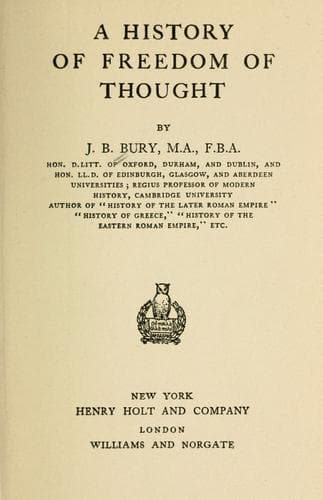
A History of Freedom of ThoughtBury, J. B. (John Bagnell)
Religion
A History of Freedom of Thought
Bury, J. B. (John Bagnell)
Free thought -- History; Rationalism -- History
[167] is reasonable; it was necessary to prove that it is real and rests
on a solid historical basis. This was the question raised in an acute
form by the criticisms of Hume and Middleton (1748) on miracles. The
ablest answer was given by Paley in his Evidences of Christianity
(1794), the only one of the apologies of that age which is still read,
though it has ceased to have any value. Paley’s theology illustrates how
orthodox opinions are coloured, unconsciously, by the spirit of the
time. He proved (in his Natural Theology) the existence of God by the
argument from design —without taking any account of the criticisms of
Hume on that argument. Just as a watchmaker is inferred from a watch, so
a divine workman is inferred from contrivances in nature. Paley takes
his instances of such contrivance largely from the organs and
constitution of the human body. His idea of God is that of an ingenious
contriver dealing with rather obstinate material. Paley’s “God” (Mr.
Leslie Stephen remarked) “has been civilized like man; he has become
scientific and ingenious; he is superior to Watt or Priestley in
devising mechanical and chemical contrivances, and is therefore made in
the image of that generation of which Watt and Priestley were
conspicuous lights.” When a God of this kind
[168] is established there is no difficulty about miracles, and it is on
miracles that Paley bases the case for Christianity—all other arguments
are subsidiary. And his proof of the New Testament miracles is that the
apostles who were eye-witnesses believed in them, for otherwise they
would not have acted and suffered in the cause of their new religion.
Paley’s defence is the performance of an able legal adviser to the
Almighty.
The list of the English deistic writers of the eighteenth century closes
with one whose name is more familiar than any of his predecessors,
Thomas Paine. A Norfolk man, he migrated to America and played a leading
part in the Revolution. Then he returned to England and in 1791
published his Rights of Man in two parts. I have been considering,
almost exclusively, freedom of thought in religion, because it may be
taken as the thermometer for freedom of thought in general. At this
period it was as dangerous to publish revolutionary opinions in politics
as in theology. Paine was an enthusiastic admirer of the American
Constitution and a supporter of the French Revolution (in which also he
was to play a part). His Rights of Man is an indictment of the
monarchical form of government, and a plea for representative democracy.
It had an enormous
Public-domain text, read in full here on John Shaqi.
Reviews
Reviews
No reviews yet
Be the first to share your thoughts on this work.
Elsewhere in the archive
Join the Discussion
Join the discussion
Sign in to leave a comment or review.
Sign InorCreate an account