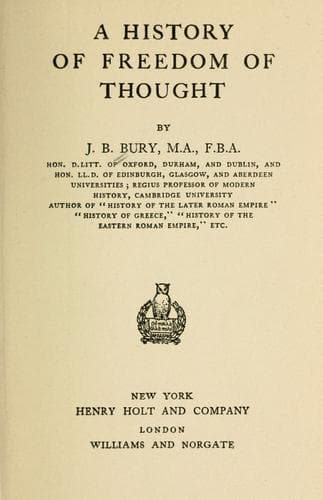
A History of Freedom of ThoughtBury, J. B. (John Bagnell)
Religion
A History of Freedom of Thought
Bury, J. B. (John Bagnell)
Free thought -- History; Rationalism -- History
[177] of modern chemistry and physics. The true nature of comets was
ascertained, and they ceased to be regarded as signs of heavenly wrath.
But several generations were to pass before science became, in
Protestant countries, an involuntary arch-enemy of theology. Till the
nineteenth century, it was only in minor points, such as the movement of
the earth, that proved scientific facts seemed to conflict with
Scripture, and it was easy enough to explain away these inconsistencies
by a new interpretation of the sacred texts. Yet remarkable facts were
accumulating which, though not explained by science, seemed to menace
the credibility of Biblical history. If the story of Noah’s Ark and the
Flood is true, how was it that beasts unable to swim or fly inhabit
America and the islands of the Ocean? And what about the new species
which were constantly being found in the New World and did not exist in
the Old? Where did the kangaroos of Australia drop from? The only
explanation compatible with received theology seemed to be the
hypothesis of innumerable new acts of creation, later than the Flood. It
was in the field of natural history that scientific men of the
eighteenth century suffered most from the coercion of authority.
Linnaeus felt it in Sweden, Buffon
[178] in France. Buffon was compelled to retract hypotheses which he put
forward about the formation of the earth in his Natural History (1749),
and to state that he believed implicitly in the Bible account of
Creation.
At the beginning of the nineteenth century Laplace worked out the
mechanics of the universe, on the nebular hypothesis. His results
dispensed, as he said to Napoleon, with the hypothesis of God, and were
duly denounced. His theory involved a long physical process before the
earth and solar system came to be formed; but this was not fatal, for a
little ingenuity might preserve the credit of the first chapter of
Genesis. Geology was to prove a more formidable enemy to the Biblical
story of the Creation and the Deluge. The theory of a French naturalist
(Cuvier) that the earth had repeatedly experienced catastrophes, each of
which necessitated a new creative act, helped for a time to save the
belief in divine intervention, and Lyell, in his Principles of Geology
(1830), while he undermined the assumption of catastrophes, by showing
that the earth’s history could be explained by the ordinary processes
which we still see in operation, yet held fast to successive acts of
creation. It was not till 1863 that he presented fully, in his Antiquity
of Man, the
Public-domain text, read in full here on John Shaqi.
Reviews
Reviews
No reviews yet
Be the first to share your thoughts on this work.
Elsewhere in the archive
Join the Discussion
Join the discussion
Sign in to leave a comment or review.
Sign InorCreate an account