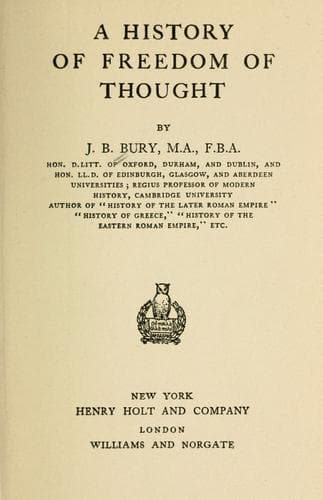
A History of Freedom of ThoughtBury, J. B. (John Bagnell)
Religion
A History of Freedom of Thought
Bury, J. B. (John Bagnell)
Free thought -- History; Rationalism -- History
[179] evidence which showed that the human race had inhabited the earth
for a far longer period than could be reconciled with the record of
Scripture. That record might be adapted to the results of science in
regard not only to the earth itself but also to the plants and lower
animals, by explaining the word “day” in the Jewish story of creation to
signify some long period of time. But this way out was impossible in the
case of the creation of man, for the sacred chronology is quite
definite. An English divine of the seventeenth century ingeniously
calculated that man was created by the Trinity on October 23, B.C. 4004,
at 9 o’clock in the morning, and no reckoning of the Bible dates could
put the event much further back. Other evidence reinforced the
conclusions from geology, but geology alone was sufficient to damage
irretrievably the historical truth of the Jewish legend of Creation. The
only means of rescuing it was to suppose that God had created misleading
evidence for the express purpose of deceiving man.
Geology shook the infallibility of the Bible, but left the creation of
some prehistoric Adam and Eve a still admissible hypothesis. Here
however zoology stepped in, and pronounced upon the origin of man. It
was an old conjecture that the higher forms of life, including
[180] man, had developed out of lower forms, and advanced thinkers had
been reaching the conclusion that the universe, as we find it, is the
result of a continuous process, unbroken by supernatural interference,
and explicable by uniform natural laws. But while the reign of law in
the world of non-living matter seemed to be established, the world of
life could be considered a field in which the theory of divine
intervention is perfectly valid, so long as science failed to assign
satisfactory causes for the origination of the various kinds of animals
and plants. The publication of Darwin’s Origin of Species in 1859 is,
therefore, a landmark not only in science but in the war between science
and theology. When this book appeared, Bishop Wilberforce truly said
that “the principle of natural selection is incompatible with the word
of God,” and theologians in Germany and France as well as in England
cried aloud against the threatened dethronement of the Deity. The
appearance of the Descent of Man (1871), in which the evidence for the
pedigree of the human race from lower animals was marshalled with
masterly force, renewed the outcry. The Bible said that God created man
in his own image, Darwin said that man descended from an ape. The
feelings of the orthodox world may be
Public-domain text, read in full here on John Shaqi.
Reviews
Reviews
No reviews yet
Be the first to share your thoughts on this work.
Elsewhere in the archive
Join the Discussion
Join the discussion
Sign in to leave a comment or review.
Sign InorCreate an account