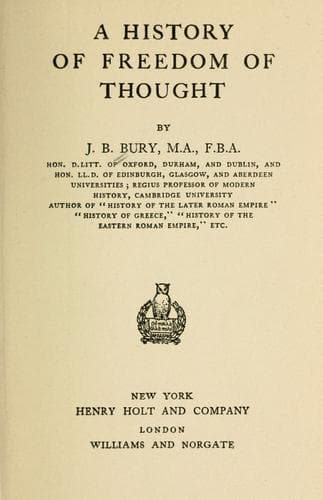
A History of Freedom of ThoughtBury, J. B. (John Bagnell)
Religion
A History of Freedom of Thought
Bury, J. B. (John Bagnell)
Free thought -- History; Rationalism -- History
Loisy is the most prominent figure in a growing movement within the
Catholic Church known as Modernism—a movement which some think is the
gravest crisis in the history of the Church since the thirteenth
century. The Modernists do not form an organized party; they have no
programme. They are devoted to the Church, to its traditions and
associations, but they look on Christianity as a religion which has
developed, and whose vitality depends upon its continuing to develop.
They are bent on reinterpreting the dogmas in the light of modern
science and criticism. The idea of development had already been applied
by Cardinal Newman to Catholic theology. He taught that it was a
natural, and therefore legitimate, development of the primitive creed.
But he did not draw the conclusion which the Modernists draw that if
Catholicism is not to lose its power of growth and die, it must
assimilate some of the results of modern thought. This is what they are
attempting to do for it.
Pope Pius X has made every effort to suppress the Modernists. In 1907
(July) he
[200] issued a decree denouncing various results of modern Biblical
criticism which are defended in Loisy’s works. The two fundamental
propositions that “the organic constitution of the Church is not
immutable, but that Christian society is subject, like every human
society, to a perpetual evolution,” and that “the dogmas which the
Church regards as revealed are not fallen from heaven but are an
interpretation of religious facts at which the human mind laboriously
arrived”—both of which might be deduced from Newman’s writings—are
condemned. Three months later the Pope issued a long Encyclical letter,
containing an elaborate study of Modernist opinions, and ordaining
various measures for stamping out the evil. No Modernist would admit
that this document represents his views fairly. Yet some of the remarks
seem very much to the point. Take one of their books: “one page might be
signed by a Catholic; turn over and you think you are reading the work
of a rationalist. In writing history, they make no mention of Christ’s
divinity; in the pulpit, they proclaim it loudly.”
A plain man may be puzzled by these attempts to retain the letter of old
dogmas emptied of their old meaning, and may think it natural enough
that the head of the Catholic
Public-domain text, read in full here on John Shaqi.
Reviews
Reviews
No reviews yet
Be the first to share your thoughts on this work.
Elsewhere in the archive
Join the Discussion
Join the discussion
Sign in to leave a comment or review.
Sign InorCreate an account