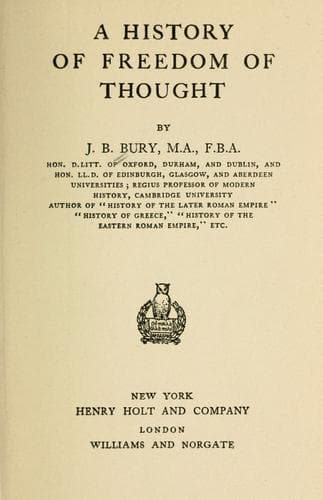
A History of Freedom of ThoughtBury, J. B. (John Bagnell)
Religion
A History of Freedom of Thought
Bury, J. B. (John Bagnell)
Free thought -- History; Rationalism -- History
[201] Church should take a clear and definite stand against the new
learning which, seems fatal to its fundamental doctrines. For many years
past, liberal divines in the Protestant Churches have been doing what
the Modernists are doing. The phrase “Divinity of Christ” is used, but
is interpreted so as not to imply a miraculous birth. The Resurrection
is preached, but is interpreted so as not to imply a miraculous bodily
resurrection. The Bible is said to be an inspired book, but inspiration
is used in a vague sense, much as when one says that Plato was inspired;
and the vagueness of this new idea of inspiration is even put forward as
a merit. Between the extreme views which discard the miraculous
altogether, and the old orthodoxy, there are many gradations of belief.
In the Church of England to-day it would be difficult to say what is the
minimum belief required either from its members or from its clergy.
Probably every leading ecclesiastic would give a different answer.
The rise of rationalism within the English Church is interesting and
illustrates the relations between Church and State.
The pietistic movement known as Evangelicalism, which Wilberforce’s
Practical View of Christianity (1797) did much to make popular,
introduced the spirit of Methodism
[202] within the Anglican Church, and soon put an end to the delightful
type of eighteenth-century divine, who, as Gibbon says, “subscribed with
a sigh or a smile” the articles of faith. The rigorous taboo of the
Sabbath was revived, the theatre was denounced, the corruption of human
nature became the dominant theme, and the Bible more a fetish than ever.
The success of this religious “reaction,” as it is called, was aided,
though not caused, by the common belief that the French Revolution had
been mainly due to infidelity; the Revolution was taken for an object
lesson showing the value of religion for keeping the people in order.
There was also a religious “reaction” in France itself. But in both
cases this means not that free thought was less prevalent, but that the
beliefs of the majority were more aggressive and had powerful spokesmen,
while the eighteenth-century form of rationalism fell out of fashion. A
new form of rationalism, which sought to interpret orthodoxy in such a
liberal way as to reconcile it with philosophy, was represented by
Coleridge, who was influenced by German philosophers. Coleridge was a
supporter of the Church, and he contributed to the foundation of a
school of liberal theology which was to make itself felt after the
middle of the century.
[203] Newman, the most eminent of the new High Church party, said that
he indulged in a liberty of speculation which no Christian could
tolerate. The High Church movement which marked the second quarter of
the century was as hostile as Evangelicalism to the freedom of religious
thought.
Public-domain text, read in full here on John Shaqi.
Reviews
Reviews
No reviews yet
Be the first to share your thoughts on this work.
Elsewhere in the archive
Join the Discussion
Join the discussion
Sign in to leave a comment or review.
Sign InorCreate an account