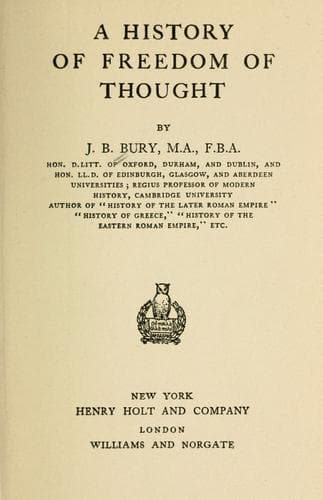
A History of Freedom of ThoughtBury, J. B. (John Bagnell)
Religion
A History of Freedom of Thought
Bury, J. B. (John Bagnell)
Free thought -- History; Rationalism -- History
The change came after the middle of the century, when the effects of the
philosophies of Hegel and Comte, and of foreign Biblical criticism,
began to make themselves felt within the English Church. Two remarkable
freethinking books appeared at this period which were widely read, F. W.
Newman’s Phases of Faith and W. R. Greg’s Creed of Christendom (both in
1850). Newman (brother of Cardinal Newman) entirely broke with
Christianity, and in his book he describes the mental process by which
he came to abandon the beliefs he had once held. Perhaps the most
interesting point he makes is the deficiency of the New Testament
teaching as a system of morals. Greg was a Unitarian. He rejected dogma
and inspiration, but he regarded himself as a Christian. Sir J. F.
Stephen wittily described his position as that of a disciple “who had
heard the Sermon on the Mount, whose attention had not been called to
the Miracles, and who died before the Resurrection.”
[204]
There were a few English clergymen (chiefly Oxford men) who were
interested in German criticism and leaned to broad views, which to the
Evangelicals and High Churchmen seemed indistinguishable from
infidelity. We may call them the Broad Church—though the name did not
come in till later. In 1855 Jowett (afterwards Master of Balliol)
published an edition of some of St. Paul’s Epistles, in which he showed
the cloven hoof. It contained an annihilating criticism of the doctrine
of the Atonement, an explicit rejection of original sin, and a
rationalistic discussion of the question of God’s existence. But this
and some other unorthodox works of liberal theologians attracted little
public attention, though their authors had to endure petty persecution.
Five years later, Jowett and some other members of the small liberal
group decided to defy the “abominable system of terrorism which prevents
the statement of the plainest fact,” and issued a volume of Essays and
Reviews (1860) by seven writers of whom six were clergymen. The views
advocated in these essays seem mild enough to-day, and many of them
would be accepted by most well-educated clergymen, but at the time they
produced a very painful impression. The authors were called the “Seven
against Christ.” It was
Public-domain text, read in full here on John Shaqi.
Reviews
Reviews
No reviews yet
Be the first to share your thoughts on this work.
Elsewhere in the archive
Join the Discussion
Join the discussion
Sign in to leave a comment or review.
Sign InorCreate an account