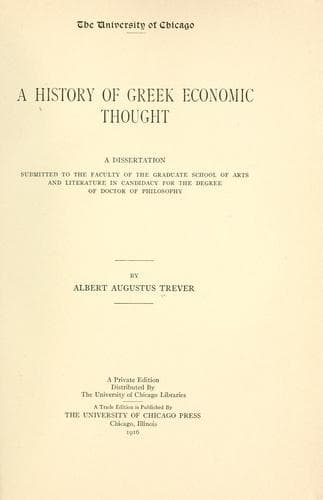
A History of Greek Economic ThoughtTrever, Albert Augustus
History
A History of Greek Economic Thought
Trever, Albert Augustus
Economics -- Greece -- History; Thesis (Ph. D.)
The Sophists, true to their character as philosophers of extreme
individualism, developed a new theory of the origin of society. The
already current term φύσις, “nature,” which had been accepted as a
sufficient reason for the state’s existence, was now opposed to “law,”
νόμος, as natural to artificial. The Sophists argued that, in a
primitive state of nature, perfect individualism was the rule. Men did
injustice without restraint. The weaker, however, being in the majority,
and finding it to their disadvantage to compete with the strong, agreed
neither to do nor to suffer injustice, and constrained the stronger
minority to co-operate in their decision. Thus arose the social contract
whereby nature gave up its real instinct for an artificial convention
(συνθήκη), and thus society came into being.[39] The theory, at first,
though untrue, was not intended to be destructive of moral foundations,
but was opposed rather to the traditional idea of the laws of a state as
the “decrees of a divinely inspired lawgiver.”[40] In the hands of men
like Thrasymachus[41] and Callicles,[42] however, it became a means of
denying that the life according to nature was bound by any laws which
the strong need observe, and that might was the only final law.
In line with their radical individualism, the Sophists were also
pioneers in the more cosmopolitan spirit that characterized the Cynics
and Stoics. They taught the doctrine of the fundamental worth and
relationship of men,[43] and thus, with the Cynics, started the attack
upon the theory that upheld slavery as a natural institution.[44] Little
further is known of their other social or economic ideas. Protagoras
wrote a work on “wages,” but it was probably an argument relative to the
acceptance of pay by Sophists.[45] In any event, this fact that the
Sophists were so ready to be enriched through their lectures is clear
evidence that their teaching on wealth was not the negative doctrine of
the other Greek philosophers.[46] Prodicus seems to have scorned menial
labor as morally degrading, though he agreed with Hesiod in his doctrine
of the dignity of all work that is noble.[47] He emphasized the
necessity of labor in the production of material good,[48] and, like
Democritus, was the forerunner of the Socratics in his insistence upon
right use as a criterion of wealth.[49] Hippias prided himself on his
accomplishment in many arts,[50] and thus probably did not share the
prejudice of the philosophers against manual labor.
Public-domain text, read in full here on John Shaqi.
Reviews
Reviews
No reviews yet
Be the first to share your thoughts on this work.
Join the Discussion
Join the discussion
Sign in to leave a comment or review.
Sign InorCreate an account