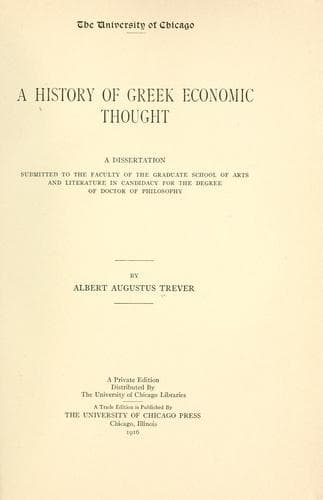
A History of Greek Economic ThoughtTrever, Albert Augustus
History
A History of Greek Economic Thought
Trever, Albert Augustus
Economics -- Greece -- History; Thesis (Ph. D.)
_Ibid._ 21-27, and entire chaps., 8-11. For terms, cf. _infra_.
Footnote 602:
iv. 1121_a_29; 1122_a_14 f.; cf. the stress on δόσις and χρῆσις rather
than on κτῆσις and λῆψις, 1120_a_8-13; _b_14-16, and Stewart’s notes,
I, 323.
Footnote 603:
_Rep._ 552B, discussed above.
Footnote 604:
Souchon (_op. cit._, p. 121) seems to think it was.
Footnote 605:
_Pol._ 1258_b_8, but cf. p. 39 and _infra_ on this word τόκος. Cf.
also Ar. _Clouds_ 20; 1285 ff.; A. Smith, _op. cit._, II, chap. iv.
Footnote 606:
Souchon (_op. cit._, p. 97) is hardly fair to Aristotle on this point,
but cf. also p. 96, n. 1; cf. Ruskin, _Time and Tide_, XV, 81 (Vol.
XVII, 388); _Mun. Pul._, Pref., 21 (Vol. XVII, 144); _ibid._, VI, 139
(p. 264); _ibid._, 153 and note (p. 277), which cites _Laws_ 743C, on
the doctrine that the just are neither rich nor poor.
Footnote 607:
_Pol._ v (viii). 2. 1337_b_8-11. The terms for mechanical labor are
τέχνη, of ability through practice; δημιουργός, of one who works for
the people, rather than for himself or one other; βάναυσος, originally
of work by the fire, but later the common term for mechanical labor,
usually with a derogatory sense in the philosophers; cf. βαναυσία,
“vulgarity,” _N. Eth._ iv. 4. 1122_a_31; βάναυσος, “vulgar man,”
_ibid._ 1123_a_19; _Etymol. mag_; Schol. to Plato _Rep._ 495E; Pollux
i. 64. 50; Hesychius, _s.v._ The Greeks did not clearly distinguish
the finer from the mechanical arts; cf. Büchsenschütz, _op. cit._, p.
266; _Pol._ vi (iv). 4. 1291_a_1 ff., where all are included under
βάναυσον. Cf. Cope-Sandys, _Ar. Rhet._, 2d ed., I, 9, 27, note. Cf.
above, p. 33, n. 7, for Ruskin’s attitude.
Footnote 608:
_Pol._ 1337_b_12; 1258_b_37.
Footnote 609:
1337_b_13 f.
Footnote 610:
1258_b_38 f.
Footnote 611:
vii (vi). 4. 1319_a_26-28.
Footnote 612:
v (viii). 2. 1337_b_5-7.
Footnote 613:
iv (vii). 9. 1328_b_37-41; cf. iii. 5. 1277_b_33 ff.
Footnote 614:
1329_a_1; 1330_a_25-31.
Footnote 615:
1330_a_25-31; cf. also the pseudo-_Econ._ i. 2. 1343_a_26 ff.
Footnote 616:
i. 3. 1260_a_40 ff.; cf. _infra_ for discussion of this idea.
Footnote 617:
1258_b_25-27; _Rhet._ i. 9. 27, 1367_a_; ἐλευθέρον γὰρ τὸ μὴ πρὸς
ἄλλον ζῆν. His entire argument for the slave as a mere “instrument”
(cf. _infra_) shows the same attitude. Stewart (_op. cit._, II, 316)
says that he failed to see that labor is “an essential function of the
social organism, something καλόν and not merely ἁναγκαῖον.”
Footnote 618:
_Pol._ iv (vii). 4. 1326_a_22-24.
Footnote 619:
1328_b_19-23; vi (iv). 1291_a_1-3.
Footnote 620:
1329_a_1; i. 11. 1258_b_38 f.
Footnote 621:
v (viii). 2. 1337_b_15-22, especially 17 f.: ἔχει δὲ πολλὴν διαφορὰν
καὶ τὸ τίνος ἕνεκεν πράττει τις ἣ μανθάνει.
Footnote 622:
Public-domain text, read in full here on John Shaqi.
Reviews
Reviews
No reviews yet
Be the first to share your thoughts on this work.
Elsewhere in the archive
Join the Discussion
Join the discussion
Sign in to leave a comment or review.
Sign InorCreate an account