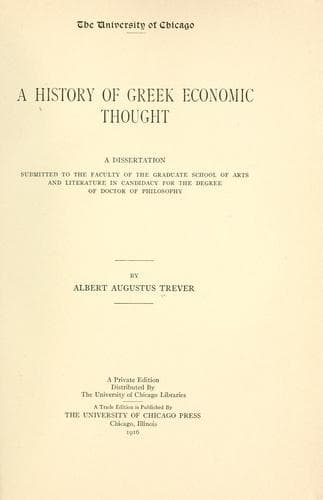
A History of Greek Economic ThoughtTrever, Albert Augustus
History
A History of Greek Economic Thought
Trever, Albert Augustus
Economics -- Greece -- History; Thesis (Ph. D.)
The difference in employments and studies is largely one of method and
aim. The most humanizing pursuit becomes ἀνελεύθερον and βάναυσον, if
followed to an extreme or with a sordid purpose, merely. Cf. Plato
_Laws_ 918B-919C, and the criticism of the superficial method and
merely vocational motive in mathematical study (_Rep._ 525C ff.). Cf.
above, p. 33, n. 7, for Ruskin’s idea on this point.
Footnote 623:
Aristotle also has the aristocratic idea of labor as robbing a freeman
of his independence, _Pol._ v (viii). 1337_b_15-22; _Rhet._ 1367_a_,
cited on p. 94, n. 9.
Footnote 624:
_Pol._ iv (vii). 9. 1328_b_39 ff.; _N. Eth._ x. 7. 1177_b_4; cf.
Jowett, _Ar. Pol._, I, 144, cited by Stewart, _op. cit._, II, 446.
Footnote 625:
_Pol._ ii 3. 1261_b_33-38.
Footnote 626:
1325_a_31-33.
Footnote 627:
1258_b_12-20.
Footnote 628:
_Rhet._ ii. 4. 9. 1381_a_, where the word αὐτουργοί is used; cf. above
on Euripides.
Footnote 629:
Cf. above on value, and _N. Eth._ v. 8-9. 1133_a_5-18.
Footnote 630:
_Pol._ vii (vi). 6. 1320_a_38 ff.; cf. p. 92, n. 6.
Footnote 631:
i. 12. 1259_b_1 ff.
Footnote 632:
1252_b_1 ff.; cf. Adam’s note to _Rep._ 370B; Susemihl and Hicks’s
note to _Pol._ 1252_b_3, for an exception to the rule (_De part.
Anim._ iv. 6. 11. 683_a_22). ἀλλ᾽ ὅπου μὴ ἐνδέχεται καταχρῆται τῷ αὐτῷ
ἐπὶ πλείω ἔργα.
Footnote 633:
_Pol._ ii 1261_a_30 f.; _N. Eth._ v. 5.
Footnote 634:
_Pol._ 1261_a_37-39; 1328_b_ ff. Fontpertuis (_op. cit._, p. 359)
accounts for the comparative superficiality of the Greek theory of
labor by the fact that their political constitution diminished its
importance, but cf. our introduction. Capitalistic employment of free
labor was probably not extensive.
Footnote 635:
Cf. above, p. 16, n. 6; p. 17, n. 1.
Footnote 636:
On the theory of the Sophists, cf. above, pp. 16 f. On the Cynics, cf.
_infra_; also Zeller, _op. cit._, II, 2, 376; Ar. _Pol._ 1253_b_20-23.
Barker (_op. cit._, p. 359), who has a very clear and discriminating
criticism of Aristotle’s theory of slavery, also states that slavery
had been attacked by the “logic of events”—e.g., the enslavement of
Athenians in Sicily, and the freeing of Messenian Helots, during the
Theban supremacy, by which Greek freemen had become slaves and Greek
slaves had become free. Cf. _Pol._ 1255_a_ ff., especially 17 f. and
21-23, for the two theories.
Footnote 637:
The _locus classicus_ for his theory is _Pol._ i. 4-7. 1253_b_14 ff.;
13. 1259_b_21 ff. For good criticisms, cf. Wallon, _Histoire de
l’esclavage dans l’antiquité_, 2d ed., pp. 372 ff.; and Barker, _op.
cit._, 1. Cf. also Newman, _op. cit._, I, 143 ff.
Footnote 638:
_Pol._ i. 8. 1256_b_36; 1253_b_32.
Footnote 639:
_Ibid._ 33-39. Aristotle would have been satisfied with electricity.
Footnote 640:
Public-domain text, read in full here on John Shaqi.
Reviews
Reviews
No reviews yet
Be the first to share your thoughts on this work.
Elsewhere in the archive
Join the Discussion
Join the discussion
Sign in to leave a comment or review.
Sign InorCreate an account