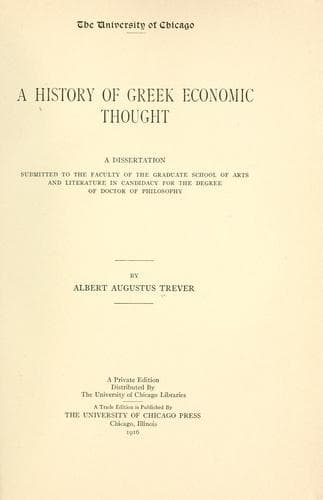
A History of Greek Economic ThoughtTrever, Albert Augustus
History
A History of Greek Economic Thought
Trever, Albert Augustus
Economics -- Greece -- History; Thesis (Ph. D.)
1254_a_8, cited on p. 88, n. 10. This relieves the severity of the
doctrine, since it shows that he thinks chiefly of domestic slavery.
But in his proposed state, all industry is manned by slaves. Cf. iv
(vii). 1330_a_25-31.
Footnote 641:
_Pol._ 1254_a_9-13; cf. _Eud. Eth._ 1241_b_17-24.
Footnote 642:
1254_a_13-17.
Footnote 643:
_Op. cit._, p. 362.
Footnote 644:
1254_a_28-31; 1254_b_15. As Wallon (_op. cit._, p. 391) points out,
his radical error is a constant confusion of hypothesis with reality.
Footnote 645:
1254_a_23-24.
Footnote 646:
_Ibid._ 33 f.
Footnote 647:
_Ibid._ 30-40; 1254_b_10-13; 1253_b_7; 18 f., cf. _Eud. Eth._
1241_b_17 ff.
Footnote 648:
1254_b_16-19.
Footnote 649:
_Ibid._ 20-26.
Footnote 650:
_Ibid._ 26 ff.
Footnote 651:
1254_a_21 f.
Footnote 652:
1254_b_6-10; 11 f.; 16-20; 1255_b_6-15; a doctrine emphasized by
Plato, _Rep._ 590D; _Laws_ 645B, 714A, 818A, 684C, as also by Carlyle
and Ruskin; cf. Shorey, _Class. Phil._, IX (1914), 355 ff. Though
Ruskin believed that natural slavery was the inevitable lot of many
men, he did not uphold negro slavery, _Mun. Pul._, v, 133 (Vol. XVII,
256 f.); Time and Tide, p. 149 (Vol. XVII, 438). But he pointed to the
white economic slavery as equally bad, _Stones of Venice_, II (Vol. X,
193); Time and Tide, p. 105 (Vol. XVII, 403); _Crown of Wild Olive_,
119; _Cestus Aglaia_, p. 55.
Footnote 653:
1254_b_32-34; 1255_b_5 ff.
Footnote 654:
1254_b_38 f.
Footnote 655:
1255_a_3-7.
Footnote 656:
_Ibid._ 19-21 and next note.
Footnote 657:
_Ibid._ 24 f.
Footnote 658:
_Ibid._ 25 f.: καὶ τὸν ἀνάξιον δουλεύειν οὐδαμῶς ἂν φαίη τις δοῦλον
εἶναι.
Footnote 659:
_Ibid._ 26-28.
Footnote 660:
_Ibid._ 33 ff.
Footnote 661:
1255_b_20-22. Barker (_op. cit._, p. 369, n. 1) well observes that
this is a challenge of the right of slavery, not an argument for it,
and that it may have impressed his contemporaries so. Cf. Ruskin: “So
there is only one way to have good servants; that is to be worthy of
being well served.” (_Letters on Servants and Houses_, Vol. XVII,
5-18, App. V); cf. also pp. 520 ff.
Footnote 662:
1259_b_26-28.
Footnote 663:
_Ibid._ 36-38.
Footnote 664:
_Ibid._ 39-41.
Footnote 665:
1260_a_2-4; 14-16; cf. 33 ff., which sets a limit on the slave’s
virtue.
Footnote 666:
1260_a_39-42; 1260_b_2 f. Cf. Ruskin, _Fors Clav._, III, Letter 28,
14, on the virtue of the “menial” condition.
Footnote 667:
Cf. Barker, _op. cit._, p. 370.
Footnote 668:
_N. Eth._ 1161_b_1-10, especially 5: ᾗ μὲν οῦν δοῦλος, οὔκ ἐστι φιλία
πρὸς αὐτόν, ᾗ δ᾽ ἄνθρωπος.
Footnote 669:
Cf. his reference to Cleisthenes’ gift of Athenian citizenship to many
slaves; also his own emancipation, by will, of five of his own slaves
(Diog. L. V. 1. 9).
Footnote 670:
Cf. Barker, _op. cit._, p. 370.
Footnote 671:
Public-domain text, read in full here on John Shaqi.
Reviews
Reviews
No reviews yet
Be the first to share your thoughts on this work.
Elsewhere in the archive
Join the Discussion
Join the discussion
Sign in to leave a comment or review.
Sign InorCreate an account