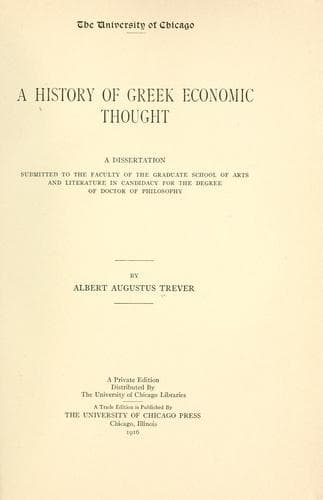
A History of Greek Economic ThoughtTrever, Albert Augustus
History
A History of Greek Economic Thought
Trever, Albert Augustus
Economics -- Greece -- History; Thesis (Ph. D.)
_Pol._ 1257_a_30 ff. These two periods of οἰκονομική and χρηματιστική
correspond well to the German terms _Naturalwirtschaft_ and
_Geldwirtschaft_. Kautz (_op. cit._, p. 137, n. 4) says that this
antithesis was about as dear to Aristotle as it is to moderns. For the
terms, cf. _infra._
Footnote 714:
_N. Eth._ v. 4. 1132_b_11-1133_b_28; cf. also under value and money,
above; cf. _Mag. mor._ i. 33. 1193_b_19 ff.
Footnote 715:
1132_b_11-20; cf. _Rep._ 369B-C; 370B, for a similar idea of Plato.
Footnote 716:
1132_b_33.
Footnote 717:
_Ibid._ 32-34, especially τῷ ἀντιποιεῖν ἀνάλογον συμμένει ἡ πίλις; 17
f.; Stewart, _op. cit._, I, 449.
Footnote 718:
1133_a_5-10, cited on p. 83, nn. 2-7; cf. _Eud. Eth._ vii. 10.
1243_b_28-38.
Footnote 719:
1133_a_10 f.
Footnote 720:
Cf. p. 83, n. 7. The less valuable product must make up in quantity
what it lacks in quality. The proportion thus becomes, γεωργός :
σκυτοτόμος : : _x_ pairs of shoes : a quantity of grain of equal value
(1133_a_32 f.). Cf. other methods of statement, 1133_b_4 f., 22
Stewart, _op. cit._, I, 453 f.
Footnote 721:
1133_b_1-4.
Footnote 722:
1133_a_11 f.; 16-18: ἑτέρων καὶ οὐκ ἴσων. Cf. _Rep._ 369C, 370B; Ar.
_Pol._ 1261_a_22 for a similar idea. Stewart (_op. cit._, I, 464 f.),
following Jackson, interprets, on the basis of 1132_a_33, the buyer’s
two advantages to be, if he buys too cheaply, the part of the article
still unpaid for, and the money he should have paid for it. Cf.
_ibid._ pp. 455-67 for other interpretations.
Footnote 723:
1133_a_15 f.: ἀνῃροῦντο γὰρ ἄν, εἰ μὴ ὁ ἐποίει τὸ ποιοῦν καὶ ὅσον καὶ
οἷον, καὶ τὸ πάσχειν ἔπασχε τοῦτο και τοσοῦτον καὶ τοιοῦτον. I follow
Jackson, note, pp. 97 f.; Rassow, _Forsch._, p. 18 (Peters’ trans., p.
154, n. 2), in accepting this difficult passage as an integral part of
its context, and in interpreting it as above, though aside from the
context, it would hardly bear this meaning. Stewart (_op. cit._, I,
455 ff.) thinks it is an interpolation or note, referring merely to
the mechanical fact in the arts that material is receptive to the
impression.
Footnote 724:
1133_a_18 f.; 25-28; 1133_b_6-8; 19 f.; cf. _Rep._ 369C.
Footnote 725:
1133_a_19-29; cf. Stewart’s excellent comments, _op. cit._, I, 459 ff.
Footnote 726:
1133_b_14-16; 20-22: τοῦτο γὰρ πάντα ποιεῖ σύμμετρα; e.g., if a house
is equal to five minae and a bed is worth one, five beds equal one
house (23-26).
Footnote 727:
_Handwörterbuch der Staatswwissenschaft_, art. “Geld,” 2d ed., Bd. IV,
82 f.
Footnote 728:
_Op. cit._, p. 384.
Footnote 729:
Cf. citations above, p. 42, n. 7, and p. 44, n. 2. Cf. DuBois, _op.
cit._, p. 46.
Footnote 730:
Cf. Haney, _op. cit._, p. 48.
Footnote 731:
_Pol._ 1259_a_2 f.; 33-35.
Footnote 732:
iv (vii). 6. 1327_a_25-30.
Footnote 733:
Public-domain text, read in full here on John Shaqi.
Reviews
Reviews
No reviews yet
Be the first to share your thoughts on this work.
Elsewhere in the archive
Join the Discussion
Join the discussion
Sign in to leave a comment or review.
Sign InorCreate an account