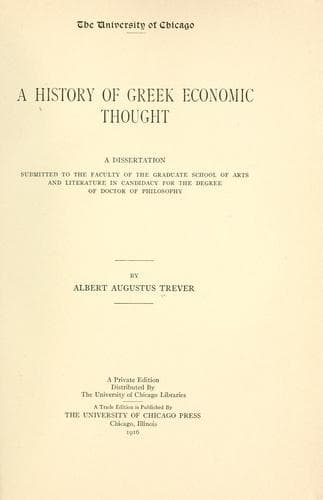
A History of Greek Economic ThoughtTrever, Albert Augustus
History
A History of Greek Economic Thought
Trever, Albert Augustus
Economics -- Greece -- History; Thesis (Ph. D.)
Aside from the fragmentary hints presented above, Greek economic thought
begins with the Socratics, Plato, Xenophon, and Aristotle, and is
continued, in a very incidental way, in the orators, and in the Stoics
and their contemporaries. As we shall see, however, even in the
Socratics, no real science of wealth is developed, in the modern sense.
The reason for this lack, which is most commonly emphasized since it is
closest at hand, is that the phenomena of actual production were but
slightly developed. This explanation is well summarized by Haney[61] as
follows: (_a_) that economic relations between individuals and states
were far simpler than now; (_b_) that international commerce was not
encouraged by ancient states, whose ideal was rather national exclusion;
(_c_) that public finance was then very limited and unimportant; (_d_)
that division of labor was not extensive; (_e_) that the relative lack
of security of life and property discouraged exchange and saving; (_f_)
that in all these respects, the situation is analogous to that of
mediaeval Europe.
There is certainly much force in this general reason. The development of
economic thought must, of course, depend upon the actual conditions
under which the thinkers live. We have already admitted also the vast
difference between the present economic complexity and the simplicity in
ancient Greece. The foregoing summary of Haney, however, is misleading.
Though the ideal of Sparta was national exclusion, it was surely not
that of Athens and some other Greek states. All extant records agree
that Athens, at least, the home of the economic theorists, encouraged
international commerce by every means in her power. The division of
labor, while insignificant compared with the minute division of modern
mechanical industry, was by no means inextensive, as is evidenced by the
fact that this is a point on which Greek thinkers show especial insight.
The notion that Greek industry was chiefly limited to household economy,
and that the era of capitalism had not yet dawned, has long ago been
refuted by Meyer and others. The alleged insecurity of life and
property, while relatively true, is exaggerated for Athens, at least.
Above all, the common attempt to draw an analogy between classical
Greece and mediaeval Europe economically is due to an utter
misconception. The period of Greek economic history, which corresponds
to that of the Middle Ages, is rather the era of economic awakening,
between the middle of the ninth and the end of the sixth century
B.C.[62]
Other reasons for the limited development of Greek economic thought are:
_a_) The dominance of the state over the individual citizen, which fact
caused political rather than economic speculation to absorb the
attention of Greek thinkers. It is stated that the importance of the
individual must be recognized before a science of economics can
develop.[63] This reason is also usually overemphasized.
Public-domain text, read in full here on John Shaqi.
Reviews
Reviews
No reviews yet
Be the first to share your thoughts on this work.
Join the Discussion
Join the discussion
Sign in to leave a comment or review.
Sign InorCreate an account