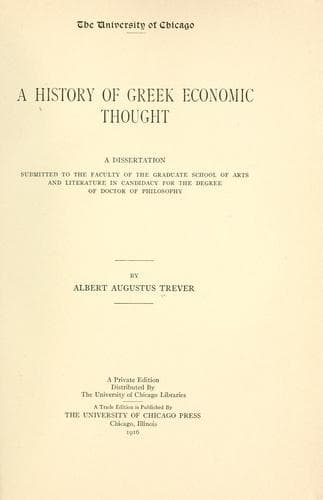
A History of Greek Economic ThoughtTrever, Albert Augustus
History
A History of Greek Economic Thought
Trever, Albert Augustus
Economics -- Greece -- History; Thesis (Ph. D.)
The most distinctive point about the doctrine of the first book is its
separation of οἰκονομική from πολιτική as a special science.[879] The
author agrees with Aristotle, however, that it is the function of
economics both to acquire and to use, though without his specific
limitations upon acquisition.[880] He distinguishes four forms of
economy—acquiring, guarding, using, and arranging in proper order.[881]
Elsewhere, he makes a different classification on another
basis—imperial, provincial, public, and private.[882] These are each
further subdivided, the first including finance, export and import
commerce, and expenditures.[883]
Agriculture is especially eulogized by the author, in the spirit of
Xenophon and Aristotle. It is the primary means of natural acquisition,
the others being mining and allied arts whose source of wealth is the
land.[884] It is the most just acquisition, since it is not gained from
men, either by trade, hired labor, or war,[885] and it contributes most
to manly strength.[886] Retail trade and the banausic arts, on the other
hand, are both contrary to nature,[887] since they render the body weak
and inefficient (ἀχρεῖα).[888]
The work agrees with Aristotle, against Plato, in his doctrine that men
and women are essentially different in nature, and hence that their work
should be distinct.[889] No attempt is made to justify slavery, though
Aristotle is followed in his advice to grant emancipation, as a special
reward for faithfulness.[890] The author of Book ii seems to have taken
for granted the Cynic theory that money need have no intrinsic value, at
least for local purposes. Coinage of iron,[891] tin,[892] bronze,[893]
the arbitrary stamping of drachmas with a double value,[894] are all
offered apparently as a proper means of escape from financial
difficulty. Like Aristotle, he accepts monopoly as a shrewd and
legitimate principle of finance.[895] Elsewhere, however, in striking
contrast to such uneconomic suggestions, the author states the important
economic principle that expenditures should not exceed income.[896] In
accord with Greek usage, he is familiar with a tax on exports for
revenue and as a means of guarding against depletion of supply.[897]
CYRENAICS
The Cyrenaics were the forerunners of the Epicureans in their more
liberal attitude toward wealth. Aristippus,[898] the founder of the
school, was a man of the world, who believed in enjoying life as it
came.[899] He held that pleasure was always a good, and that all else
was of value only as a means of realizing this end.[900] If consistent,
therefore, he must have valued highly moderate wealth. His principle
that one should aim to realize the highest degree of pleasure with the
least economic expenditure is somewhat analogous to the modern economic
doctrine of the smallest means.[901] Bion of Borysthenes became a
Cyrenaic in his later life, but his satires are almost entirely
lost.[902]
Public-domain text, read in full here on John Shaqi.
Reviews
Reviews
No reviews yet
Be the first to share your thoughts on this work.
Elsewhere in the archive
Join the Discussion
Join the discussion
Sign in to leave a comment or review.
Sign InorCreate an account