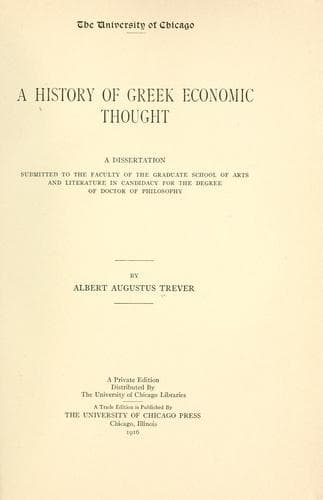
A History of Greek Economic ThoughtTrever, Albert Augustus
History
A History of Greek Economic Thought
Trever, Albert Augustus
Economics -- Greece -- History; Thesis (Ph. D.)
Poverty, on the other hand, does not change the disposition of the
temperate man for the worse[988] There is nothing distressing or painful
about it,[989] for Crates and Diogenes were poor and yet passed their
life in ease.[990] It is no harder to endure old age in poverty than in
wealth, but all depends upon the disposition.[991] Poverty deprives the
life of no positive good, but furnishes the opportunity of gaining
good,[992] since it is conducive to the contemplative life of
philosophy, while wealth is an obstacle to this.[993] It is the poor,
rather than the wealthy, who have leisure.[994] They are also obliged to
be strong (καρτερεῖν), while the wealthy become effeminate, since they
have no impetus to work.[995] Thus poverty, when accompanied with
justice, should be more highly honored than wealth.[996] The author
concludes that it is therefore best to despise wealth and turn to the
life of philosophy, for this develops generosity instead of stinginess,
and contentment instead of insatiety. Such a life uses what is on hand,
and lives content with present blessings (τοῖς παροῦσι).[997] The marked
contrast between this ascetic philosophy of poverty and the saner
teaching of Plato, who was as much opposed to poverty as to excessive
wealth, is patent.
STOICS
The Stoics were the natural descendants in thought of the Cynics, whom
they resemble closely in their attitude toward external goods. According
to their definition, a good must have an unconditioned value
(_absolutum_, αὐτελές). Whatever exists merely for the sake of something
else, or is of value only in comparison to something else, is not a
good.[998] A similar doctrine was held concerning evil. Thus spiritual
goods were counted to be the only true wealth,[999] and he who had the
right attitude toward all,[1000] and used all rightly, was thought to be
the spiritual owner of all.[1001]
Zeno, the founder of the school,[1002] classified both wealth and
poverty among the so-called “indifferents” (ἀδιάφορα),[1003] as neither
good nor evil _per se_. Like the Cynics, he eulogized poverty, though
not to such an extreme degree.[1004] He went with them only so far as to
insist that wealth and poverty have no value, except in relation to the
proper spiritual attitude.[1005]
Public-domain text, read in full here on John Shaqi.
Reviews
Reviews
No reviews yet
Be the first to share your thoughts on this work.
Elsewhere in the archive
Join the Discussion
Join the discussion
Sign in to leave a comment or review.
Sign InorCreate an account