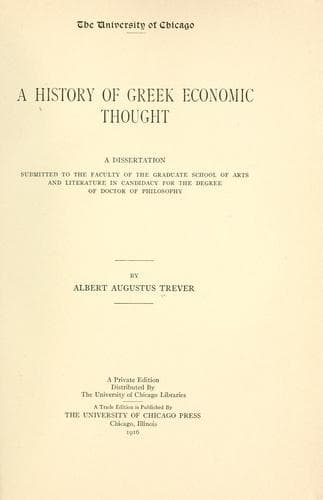
A History of Greek Economic ThoughtTrever, Albert Augustus
History
A History of Greek Economic Thought
Trever, Albert Augustus
Economics -- Greece -- History; Thesis (Ph. D.)
In his argument that temples are not especially holy places, since they
are the work of artisans (βαναύσων), Zeno exhibits the common negative
attitude of the philosophers toward manual labor.[1006] His doctrine on
money and exchange was also the negative teaching of the moralist,
though his statements on these matters have special reference to an
ideal future.[1007] His attitude on the problem of distribution is not
altogether clear, though he wrote a _Republic_,[1008] in which he seems
to have presented some communistic ideas. Like his followers, he looked
to the time when the whole world should be one state, where artificial
differences were no more, and all men were brothers.[1009] His state is
utopian and anarchistic, without temple, court, gymnasium, money, or
exchange. All are to wear the same clothing, and there shall be no
artificial modesty.[1010] Community of wives, at least for the wise, was
also probably among his utopian schemes,[1011] though it is very
unlikely that he held the doctrine in the crass form as reported.[1012]
His state is somewhat suggestive of the Christian ideal, as a unitary
whole, a world-cosmos, united by love.[1013]
There is a peculiar mixture of individualistic and social conceptions in
the philosophy of the Stoics. In their pictures of an ideal future
world-state, they advanced beyond Plato and other thinkers, who limited
their communities to the small city-state. In calling their state a
“cosmos” also, they gave a positive social content to the narrow
individualism of the Cynics.[1014] Moreover, as seen above, their ideal
undoubtedly contained some communistic elements. However, according to
the fundamental tenet of Stoicism, as expressed by Zeno,[1015] that only
the wise can be free and citizens, we are still faced with the old
duality and anti-socialistic ideal. The Stoics, like the Cynics, were
after all essentially individualistic, and were probably believers in
private ownership, though they dreamed of a future golden age of
altruism, when private property would be no longer necessary.[1016]
Public-domain text, read in full here on John Shaqi.
Reviews
Reviews
No reviews yet
Be the first to share your thoughts on this work.
Elsewhere in the archive
Join the Discussion
Join the discussion
Sign in to leave a comment or review.
Sign InorCreate an account