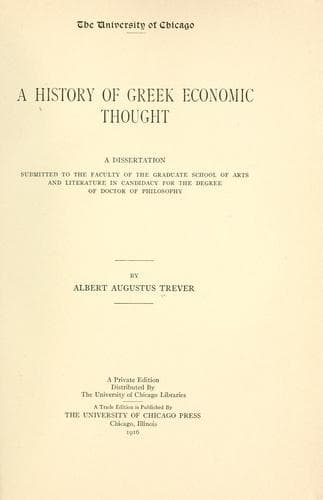
A History of Greek Economic ThoughtTrever, Albert Augustus
History
A History of Greek Economic Thought
Trever, Albert Augustus
Economics -- Greece -- History; Thesis (Ph. D.)
Cf. Barker, _op. cit._, p. 37; cf. above on Sophists; also Dunning,
_Political Theories Ancient and Mediaeval_ (1913), pp. 103 f.
Footnote 914:
Cf. Hasbach, _Allgemeine philosophische Grundlagen der Pol. Econ._
(1890), pp. 76 and 36 f.; Dunning, as above.
Footnote 915:
For his life, cf. Zeller, II, 1, 280 ff., and Diog. L. vi. A few
fragments of his philosophical dialogues are extant. Cf. above, p.
126, n. 7. for his _Economicus_. He and Diogenes are discussed at this
point, since the Cynic movement as a whole is logically
post-Aristotelian.
Footnote 916:
Diog. L. vi. 1. 15; cf. Gomperz, _op. cit._, II, 117 and note, with
citations from Dio of Prusa; also Zeller, _op. cit._, II, 1, 325 f.
and note, who thinks Plato’s ironical “city of pigs” (_Rep._ ii) may
well have been a reference to the ideas of Antisthenes.
Footnote 917:
Cf. preceding note, and _infra_, on later ideal states.
Footnote 918:
_Pol._ i. 1253a1-4: ἄνθρωπος φύσει πολιτικὸν ζῷον, etc.
Footnote 919:
Dionis Prus. _Opera_ (ed. Arnim, 1893, or vi. 25 f.), ascribed to
Diogenes, but it was also the idea of Antisthenes. Cf. Gomperz, _op.
cit._, II, 118; compare Rousseau.
Footnote 920:
Diog. L. vi. 104.
Footnote 921:
_Ibid._ vi. 12; cf. chap. 9, 105.
Footnote 922:
Xen. _Symp._ iv. 34, 34-43, on the advantages and disadvantages of the
two kinds of wealth; iii. 8; _Econ._ i. 7 f.; ii. 2 f.
Footnote 923:
Xen. _Symp._ iv. 35
Footnote 924:
Mullach, _op. cit._, II, p. 289, fr. 86: φιλάργυρος.
Footnote 925:
Diog. L. vi. 2, καὶ ὅτι ὁ πόνος ἀγαθὸν συνέστησε διὰ τοῦ μεγάλου
Ἡρακλέους καὶ τοῦ κύρου. Heracles, the toiler, was their patron saint.
Antisthenes is said to have written two dialogues called Heracles
(Diog. L. vi. 2. 18), but Zeller, (_op. cit._, II, 1, 307, n. 4)
thinks only one was genuine.
Footnote 926:
Cf. _infra_ on Diogenes. Ar. _Pol._ 1253b20-22 probably refers to the
Cynics, as holding it to be κατὰ φύσιν, οὐδὲ δίκαιων, and βίαιων. Cf.
Newman, _op. cit._, I, 140, n. 2, on this. He cites Strabo, p. 15;
110, on the opposition of the Cynic Onesicritus to slavery. Cf. above,
pp. 97 ff.; Zeller, _op. cit._, II, 1, 280 ff., 323 f.
Footnote 927:
Cf. _infra_ on Diogenes and _Eryxias_; Ar. _Pol._ 1257_b_10, probably
Cynic.
Footnote 928:
412-323 B.C.; cf. Zeller, _op. cit._, II, 1, 280 ff.
Footnote 929:
Mullach, _F.Ph.G._, II, 326, fr. 276; cf. Diog. L. vi. 47: τὸν
πλούσιον ἀμαθῆ, πρόβατον εἶπε χρυσόμαλλον.
Footnote 930:
Mullach, II, 302, fr. 27; 327, fr. 285; cf. _infra_ on Teles, for like
idea.
Footnote 931:
Mullach, II, 316, fr. 168; Chrysost. _Homil._ lxiv in Matthew points
to Paul’s parallel, I Tim. 6: 10: ῥἰζα γὰρ πάντων τῶν κακῶν ἐστιν ἡ
φιλαργυρία.
Footnote 932:
Mullach, II, 305, fr. 63.
Footnote 933:
_Ibid._ fr. 66; 65.
Footnote 934:
_Ibid._ fr. 61; p. 327, fr. 285.
Footnote 935:
Public-domain text, read in full here on John Shaqi.
Reviews
Reviews
No reviews yet
Be the first to share your thoughts on this work.
Elsewhere in the archive
Join the Discussion
Join the discussion
Sign in to leave a comment or review.
Sign InorCreate an account