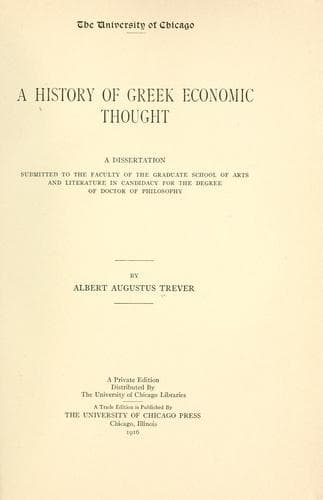
A History of Greek Economic ThoughtTrever, Albert Augustus
History
A History of Greek Economic Thought
Trever, Albert Augustus
Economics -- Greece -- History; Thesis (Ph. D.)
Gomperz, _op. cit._, II, 133; Zeller (_op. cit._, II, 1, 323 f.) is
not sure that the Cynics taught a positive anti-slavery doctrine, but
cf. p. 132, n. 2.
Footnote 936:
Diog. L. vi. 66, 74 f.; cf. Epict. _Dissert._ iii. 24. 67.
Footnote 937:
_Athen._ iv. 159_c_; Διογένης δ᾽ ἐν τῇ πολιτείᾳ νόμισμα εἶναι
νομοθετεῖ ἀστραγάλους.
Footnote 938:
Diog. L. vi. 72: ἔλεγε δὲ καὶ κοινὰς εἶναι δεῖν τὰς γυναῖκας, etc.
Aristotle (_Pol._ ii. 7. 1266_a_34) names Plato as its sole advocate,
but cf. Zeller, _op. cit._, II, 1, 321 f., n. 4, and Gomperz, _op.
cit._, II, 132, though they think that he did not hold it in the
extreme form stated by Diogenes Laertius.
Footnote 939:
There is no specific evidence, though it would accord well with his
other teachings. Cf. Gomperz, _op. cit._, II, 132.
Footnote 940:
Called “Thebaios”; flor. _ca._ 328 B.C.; cf. Diog. L. vi. 87.
Footnote 941:
Mullach, _F. Ph. G._, II, 334, fr. 6; 338, frs. 38, 39; cf. also Diog.
L. vi. 86.
Footnote 942:
Cf. _The Beggar’s Wallet_, an amusing parody of the _Odyssey_ (von
Arnim, _Leben und Werke des Dio von Prusa_ [1898], 255 ff.) Gomperz
(_op. cit._, II, n. 545 to p. 125) doubts its genuineness for Crates,
but thinks it is from a Cynic source; cf. also _infra_ on Teles.
Footnote 943:
The pseudo-Aristotelian _Economics_ is a possible exception. The
_Economics_ of Xenophon has a broader theme, and the _Revenues_ is for
practical purposes.
Footnote 944:
_Pseudo-Platonica_, p. 59.
Footnote 945:
It is given mere passing mention in Boeckh, _op. cit._, I, 693;
Hoderman, _op. cit._, p. 9; Francotte, _L’Industrie_, II, 310, n. 1;
Cossa, _op. cit._, p. 146; Oncken, _op. cit._, p. 37; Bonar, _op.
cit._, p. 11, n. 1; Kautz, _op. cit._, p. 121; Simey, _op. cit._, p.
474; Hagen, _Observationum oec. pol. in Aesch. dialog., qui Eryx.
inscribitur_ (dissertation, 1822). The latter has not been examined.
Footnote 946:
On its origin, cf. Otto Schrohl, _De Eryx. qui fertur Platonis_
(dissertation, 1901) which gives a full bibliography, pp. 5 ff.;
Heidel (_Pseudo-Platonica_, p. 61), following Steinhart (Mueller, VII,
14), attributes it to a later Socratic, in sympathy with Antisthenes;
p. 69, n. 3, he thinks it grew out of _Euthyd._ 288E ff.; for other
points of contact, cf. Schrohl, 10 ff.
Footnote 947:
On the first, cf. 393A-394E, 402E-403C; on the second, cf. 396E-397D,
405C-406B.
Footnote 948:
Cf. preceding n. 3.
Footnote 949:
278E-282.
Footnote 950:
Cf. above, _in loc._
Footnote 951:
For Stoics, cf. _infra_.
Footnote 952:
Xen. _Mem._ i. 6, especially end: ἐγὼ δὲ νομίζω τὸ μὲν μηδενὸς δεῖσθαι
θεῖον εἶναι, etc.; cf. Schrohl, _op. cit._, pp. 26-28.
Footnote 953:
400E, 401A.
Footnote 954:
401A: ἀλλὰ ποῖα δὴ τῶν χρησίμων, ἐπειδή γε οὐ πάντα. Cf. also 400E.
Footnote 955:
401B, 401E.
Footnote 956:
402E, 393E-394E, and the general thesis that the wisest are richest.
Public-domain text, read in full here on John Shaqi.
Reviews
Reviews
No reviews yet
Be the first to share your thoughts on this work.
Elsewhere in the archive
Join the Discussion
Join the discussion
Sign in to leave a comment or review.
Sign InorCreate an account