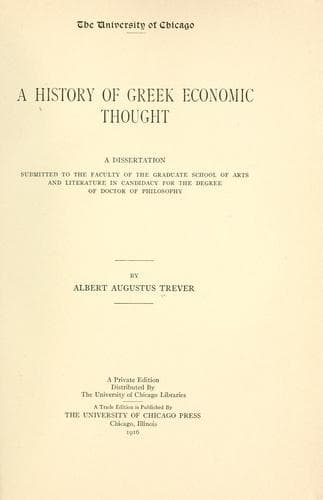
A History of Greek Economic ThoughtTrever, Albert Augustus
History
A History of Greek Economic Thought
Trever, Albert Augustus
Economics -- Greece -- History; Thesis (Ph. D.)
Footnote 957:
400A-E, 394D, arguing that economic demand might make a man’s wisdom
more valuable than another’s house.
Footnote 958:
399E.
Footnote 959:
Cf. 399E, where Eristratos defines πλοῦτος as τὰ χρήματα πολλὰ
κεκτῆσθαι.
Footnote 960:
393A, 393D-394A; cf. above, pp. 24 ff. and notes for Plato and others.
Footnote 961:
394D-E, 402E.
Footnote 962:
393E, 396E-397E, 403E, the insistence upon ability to use, so common
in Plato, Xenophon, and Ruskin.
Footnote 963:
394D-E, which reads like a passage from the New Testament.
Footnote 964:
397E.
Footnote 965:
396C: ἂν μέν τι ἕχῃς, ἄξιός του, ἐὰν δὲ μή, οὐδενός. Cf. _The Simple
Life_: “He who has nothing is nothing.” Cf. Eurip. fr. 328, Danae
(Nauck): κακὸς δ᾽ ὁ μὴ ἔχων, οἱ δ᾽ ἔχοντες ὄλβιοι.
Footnote 966:
396E-397E; cf. _infra_, the Stoic doctrine of “indifferents”; but they
included health and wealth in the same class, while the _Eryxias_ does
not. Cf. Diog. L. vii. 103; cf. a similar passage in the _Euthydemus_;
cf. Schrohl, _op. cit._, p. 34.
Footnote 967:
396E-397E, as above; 393A.
Footnote 968:
405D.
Footnote 969:
405E.
Footnote 970:
406B.
Footnote 971:
_Ibid._, but cf. 134, n. 8, where Socrates approaches this asceticism.
Footnote 972:
403E, distinguishing the materials of a house, the tools by which they
are provided, and the tools for building. Cf. Plato and Aristotle, _in
loc._, for a like distinction.
Footnote 973:
399E.
Footnote 974:
400A-E.
Footnote 975:
400A-B. Heidel (_op. cit._, p. 61) points to his “ostentatious display
of learning” here.
Footnote 976:
402B-C, 404A-B.
Footnote 977:
400E.
Footnote 978:
400C-E, especially ὅσα μέν ἄρα τυγχάνει χρήσιμα ὄντα ἡμῖν ταῦτα
χρήματα, though at this point the term has been made to include all
wealth; cf. also 402C: ἀλλὰ ταῦτ᾽ ἂν εἴν (χρήματα) οἷς τὰ χρήσιμα οἶοί
τ᾽ ἐσμὲν ἐκπορίζεσθαι.
Footnote 979:
Cf. _Teletis Reliquiae_, ed. Hense, Freiburg, 1889. The ancient source
is Stobaeus. Teles, a Cynic of Megara, wrote about 240 B.C. Cf. Hense,
_op. cit._, XXI-XXXV; Gomperz, _op. cit._, II, 129 ff. Fr. iv. A, pp.
24 ff., and iv. B, p. 34, are of special economic interest.
Footnote 980:
Fr. IV, A, pp. 24 ff.
Footnote 981:
Fr. IV, A, p. 24: δι᾽ ἀνελευθερίαν καὶ ῥυπαρίαν.
Footnote 982:
_Ibid._ 27; cf. the example of the Φορκίδες, who have an eye, but do
not use it; cf. also the quotation from the “ancients” on the
distinction between χρήματα, “used wealth,” and κτήματα, “wealth
merely possessed” (ll. 13 f.).
Footnote 983:
P. 32, the unsated life will not be satisfied even with immortality,
since it cannot become Zeus. L. 13 ff., kings are always in want,
σπανίζουσιν. Cf. Xen. _Symp._ iv. 36.
Footnote 984:
P. 26, ll. 4 f., 6-12; p. 31.
Footnote 985:
P. 28, ll. 13-29.
Footnote 986:
P. 29, ll. 6 ff.
Footnote 987:
P. 29; cf. pp. 30 f.; p. 26, ll. 11 f.
Footnote 988:
P. 26.
Footnote 989:
Public-domain text, read in full here on John Shaqi.
Reviews
Reviews
No reviews yet
Be the first to share your thoughts on this work.
Elsewhere in the archive
Join the Discussion
Join the discussion
Sign in to leave a comment or review.
Sign InorCreate an account