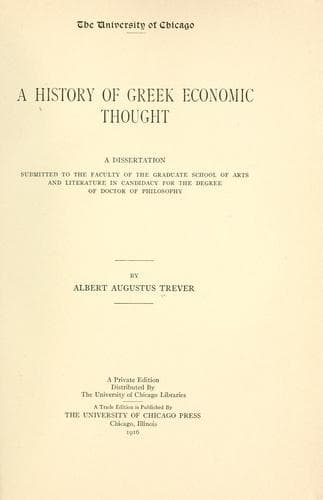
A History of Greek Economic ThoughtTrever, Albert Augustus
History
A History of Greek Economic Thought
Trever, Albert Augustus
Economics -- Greece -- History; Thesis (Ph. D.)
_Erga_ 308, 314, 397 f., 311 (ἔργον δ᾽ οὐδὲν ὄνειδος, ἀεργίη δέ τ᾽
ὄνειδος), 310, 303-6, 413. Any material in Homer applies rather to a
history of economic conditions. Cf., however, _Il._ xiii. 730-32; iii.
65; xxiii. 667 on specialization of gifts.
Footnote 20:
Cf. _Erga_ and _Theogony_ 969-75; cf. n. 2.
Footnote 21:
Cf. n. 2 above; a common theme of seventh- and eighth-century poets;
cf. e.g., Sappho (Bergk-Hiller, _Lyr. G. Vet._ [1897], I, 204, fr. 79
[45]); ὁ πλοῦτος ἄνευ τὰς ἀρετὰς οὐκ ἀσίνης πάροικος. Cf. also III,
168, fr. 49 (50), Alcaeus.
Footnote 22:
_Erga_ 25 f.
Footnote 23:
Cf. his poems, especially fr. xiii. 43 ff.; Ar. _Ath. Pol._ x. 1;
Plut. _Solon_ 15, 22-24; Kautz, _op. cit._, pp. 114 f. and note, on
Solon and the other lawgivers; Gilliard, _Quelque Réformes de Solon_.
Cornford (_Thucydides Mythhistoricus_, p. 66) thinks he was “on the
verge” of discovering the law that exports must balance imports.
Footnote 24:
_Elegies_ 1117 f., 227 ff., 1157 f., 181 f., 267 ff., 173 ff., 351
ff., 393 ff., 523 ff., 621 f., 199 ff., 753, 145 f., 559 f., etc.
Footnote 25:
On this error, cf. _infra_, on communism before Plato.
Footnote 26:
Cf. Kautz, _op. cit._, p. 114; Jamblichus, _De Pyth. vit._, chap. xii,
p. 58; chap. xvi, p. 69.
Footnote 27:
Diels, _Frag. d. Vorsokratiker_ (1912), II, 20, 69.
Footnote 28:
_Ibid._, p. 95, fr. 171; p. 73, fr. 40.
Footnote 29:
_Ibid._, p. 119, fr. 283.
Footnote 30:
_Ibid._, p. 77, fr. 77; cf. Stob. _Flor._ 94. 24; χρημάτων χρῆσις ξὺν
νόῳ μὲν χρήσιμον εἰς τὸ ἐλευθέριον εἶναι καί δημοφελέα· ξὺν ἀνοίῃ δὲ
χορηγίῃ ξυνή. Cf. Xenophon and Plato, _infra_, on value and wealth.
Footnote 31:
_Ibid._, p. 78, fr. 78.
Footnote 32:
_Ibid._, p. 105, frs. 200, 218, 221.
Footnote 33:
_Ibid._, fr. 219; p. 106, fr. 224. The ethical fragments of
Democritus, cited above, may be spurious. Cf. Mullach, _Frag. Phil.
Gr._, I, 138; Zeller (_Gesch. d. Gr. Phil._ I, 2, 925, n. 1) leaves
the question open. Diels (_op. cit._, II, 1912) cites the above
passages under the “echte fragmente,” though some are starred.
Footnote 34:
Cf. Barker, _op. cit._, p. 37.
Footnote 35:
Diels, _op. cit._, I, 83, fr. 29; οἱ δὲ πολλὸι κεκόρηται ὁκώσπερ
κτήνεα.
Footnote 36:
_Ibid._, p. 82, fr. 22; cf. Clem. Alex. _Strom._ iv. 2. p. 565, and
his comment.
Footnote 37:
Diels, _op. cit._, I, 95, fr. 90: πυρὸς ἀνταμείβεται πάντα καὶ πῦρ
ἀπάντων, ὥσπερ χρυσοῦ χρήματα καὶ χρημάτων χρυσὸς.
Footnote 38:
_Pol._ ii; cf. _infra_ for details.
Footnote 39:
Cf. Glaucon’s tentative argument presenting the Sophist theory, _Rep._
358E ff., very similar to that of Hobbes. Cf. Barker’s (_op. cit._,
pp. 27 ff.) excellent presentation of the rise of this theory and its
causes.
Footnote 40:
Public-domain text, read in full here on John Shaqi.
Reviews
Reviews
No reviews yet
Be the first to share your thoughts on this work.
Join the Discussion
Join the discussion
Sign in to leave a comment or review.
Sign InorCreate an account