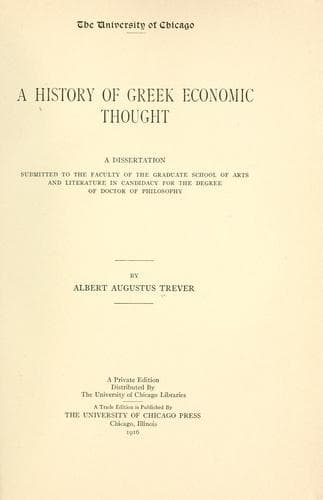
A History of Greek Economic ThoughtTrever, Albert Augustus
History
A History of Greek Economic Thought
Trever, Albert Augustus
Economics -- Greece -- History; Thesis (Ph. D.)
Such a list of positive economic principles and practical suggestions
should surely give the Greeks some claim to recognition in the field of
economic thought. But they should be judged primarily, not by their
positive contribution to economic theory or by the practical nature of
their suggestions for legislation, but rather by the extent to which
they realized the existence of the great economic and social problems,
which are still crying for a solution. From this standpoint, we have
seen that Plato and Aristotle especially reveal remarkable economic
insight. Moreover, there still remains the outstanding fact that the
Greeks were the forerunners of the moral, humanitarian, and social
emphasis in present-day economy. This alone should give to them a
distinct place in the evolution of economic thought, and should make it
impossible for Souchon to conclude: “Ces mépris [of G. B. Say] sont pour
nous apparaître plus justifiés que les admirations de Roscher.”[1060]
The influence of Greek thought upon later economic theory, however,
seems not to have been very direct or extensive, probably owing to the
incidental nature of their speculation. To be sure, mediaeval economic
thought presents, in many respects, an unbroken continuity with the
Greek. In their emphasis on the moral, in their doctrines on usury, just
price, importance of agriculture, exchange for profit, and in their
general conservative attitude toward money and commercial development,
mediaeval thinkers are very similar to the Socratics.[1061] Doubtless
much of this similarity may be traced to the direct influence of
Aristotle, as is especially evident in the work of Thomas Aquinas and
Nicholas Oresme.[1062] To a considerable extent, however, the economic
ideas of the Middle Ages were a direct outgrowth of the economic and
religious conditions under which the writers lived.[1063] In the
following centuries, some Greek influence may be traced in Adam Smith,
in the physiocrats,[1064] in utopian writers such as More, and in
eighteenth-century thinkers like Rousseau.
Public-domain text, read in full here on John Shaqi.
Reviews
Reviews
No reviews yet
Be the first to share your thoughts on this work.
Elsewhere in the archive
Join the Discussion
Join the discussion
Sign in to leave a comment or review.
Sign InorCreate an account