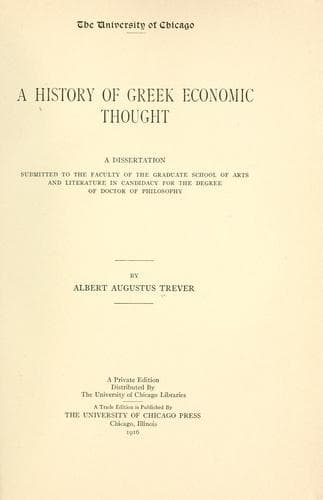
A History of Greek Economic ThoughtTrever, Albert Augustus
History
A History of Greek Economic Thought
Trever, Albert Augustus
Economics -- Greece -- History; Thesis (Ph. D.)
It is usually asserted that the economic thought of the past century has
been practically unaffected by Greek ideas. But our previous discussion
has clearly shown that Plato and Xenophon, at least, dominated the
economic thinking of Ruskin. If further evidence is needed, it is
necessary only to turn to the names of Greek thinkers in the index to
the monumental new edition of his works, which we have frequently cited
above. He frankly and enthusiastically presents himself as an apostle of
a “Greek theory of economics.”[1065] But despite some of his utopian and
extravagant ideas, he is being ever more recognized by authorities in
economics as having been one of the chief factors in the development of
political economy to its present moral and humanitarian emphasis.[1066]
His repudiation of the abstract “economic man,” his insistence upon
human, moral, and social ideals in economics, his attempt to broaden the
definition of economic value and wealth by emphasizing true utility, his
constant stress upon proper consumption rather than upon production, his
demand that all have opportunity up to their capacity, his opposition to
the _laissez-faire_ policy in economics and politics, his emphasis upon
right education, all have borne rich and abiding fruit in the last few
decades, and these are all distinctively Greek ideas, as we have seen
above. Thus indirectly, through Ruskin, Greek economic thought has
exerted a potent influence upon the evolution of nineteenth-century
economics, and thus there is much truth in the words of Wagner, as
quoted by Oncken,[1067] not merely for German, but for all modern
economy: “Es ist im Grunde uralter wahrhaft classischer Boden, auf den
jetzt die deutsche ökonomische und soziale Theorie und Praxis sich
bewusst wieder stellen.” Souchon’s characterization of Greek economy as
“morale étatisme”[1068] could well be applied to much in the economic
thought of today.
Footnote 1060:
_Op. cit._, p. 195; Roscher is, of course, extreme in his
appreciation.
Footnote 1061:
Cf. Brants, _Les théories écon. au XIII et XIV siècle_; Espinas,
_Histoire des doctrines économiques_, pp. 72 ff.; Haney, _op. cit._,
pp. 69 ff.
Footnote 1062:
In his _De origine, natura, jure, et mutationibus monetarum_
(fourteenth century). On their dependence upon Aristotle, cf. Zmavc,
_Zeitschr. f. d. gesammt. Staatswiss._, 1902, pp. 54 and 77 f.; and
_Archiv f. d. Gesch. der Phil._, 1899, 407 ff.
Footnote 1063:
Cf. Souchon, pp. 199 f., who observes that the Greek moral goal was
perfection of the individual through the state, while that of the
Middle Ages was individual salvation to another world.
Footnote 1064:
Cf. Oncken, _op. cit._, p. 38.
Footnote 1065:
Public-domain text, read in full here on John Shaqi.
Reviews
Reviews
No reviews yet
Be the first to share your thoughts on this work.
Elsewhere in the archive
Join the Discussion
Join the discussion
Sign in to leave a comment or review.
Sign InorCreate an account