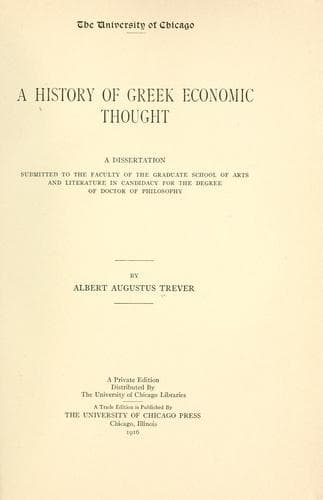
A History of Greek Economic ThoughtTrever, Albert Augustus
History
A History of Greek Economic Thought
Trever, Albert Augustus
Economics -- Greece -- History; Thesis (Ph. D.)
As seen above, Plato was the first great economic thinker of Greece.[68]
Plato, however, was primarily interested in neither economics nor
politics, but in moral idealism. He is pre-eminent, even among the
Socratics, for this. All his economic thought is a direct outgrowth of
it, and is shot through with its influence. Yet, despite this fact, he
exhibits considerable insight into some of the basal principles of
economics,[69] and his entire _Republic_ is founded upon an essentially
economic theory of society. He traces its origin to mutual need,[70] and
makes little of the innate social impulse, so prominent in Aristotle’s
analysis.[71] He is the predecessor of Aristotle, however, in opposing
the social contract doctrine of the Sophists with its interpretation of
law as mere convention, by a natural theory of social origins. To his
thought, the very foundations of society are established in eternal
justice. They are not the result of mere convention, nor altogether the
work of inspired lawgivers, but a complex product of natural and
artificial elements.[72]
VALUE
Strictly speaking, Plato’s contribution to a theory of economic value
and a definition of wealth is practically nil. In his discussion of just
price, he merely hints at the fact of exchange value. He implies that,
since goods exchange according to definite proportions, they should have
a common quality capable of measurement, and that just price corresponds
to this.[73] He offers no suggestion as to the nature of this quality,
except that, in stating that “the artisan knows what the value of his
product is,” he seems to be thinking of labor, or cost of production, as
the chief element in value.[74]
In other passages, he insists on the doctrine taught previously by
Democritus,[75] and later by Xenophon and other philosophers, that
so-called goods depend for their value upon the ability of the possessor
to use them rightly.[76] This idea is represented in modern thought
especially by Ruskin.[77] The theory is, of course, true of absolute
value, and, in a sense, even of economic value, in that “all
exchangeableness of a commodity depends upon the sum of capacity for its
use.”[78] It cannot be made a criterion of economic value, though the
allied idea, implied by Plato and urged by Ruskin, that the innate
quality of the thing, its capacity for good or harm, is a real element
in economic value, is being recognized today. This is evident in the
increasing hostility toward such so-called commodities as opium and
intoxicating liquors. Since we have begun to define political economy in
terms of human life rather than in terms of property, Ruskin’s
definition of wealth is more acceptable: “the things which the nature of
humanity has rendered in all ages, and must render in all ages to come
... the objects of legitimate desire.”[79]
WEALTH
Public-domain text, read in full here on John Shaqi.
Reviews
Reviews
No reviews yet
Be the first to share your thoughts on this work.
Join the Discussion
Join the discussion
Sign in to leave a comment or review.
Sign InorCreate an account