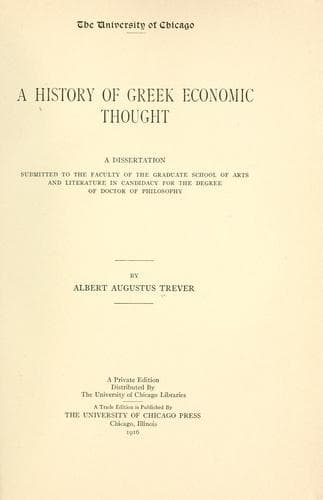
A History of Greek Economic ThoughtTrever, Albert Augustus
History
A History of Greek Economic Thought
Trever, Albert Augustus
Economics -- Greece -- History; Thesis (Ph. D.)
However, Plato has no prejudice against moderate wealth. His sermons are
directed against excessive commercialism, which puts money before the
human interest,[101] thereby causing injustice, degenerate luxury,
vicious extremes of wealth and poverty, political graft, individual
inefficiency, and wars both within and without the state. Though his
philosophy leads to asceticism, and his attitude toward wealth seems, on
the surface, to breathe this spirit, yet Plato is not an ascetic in his
doctrine of wealth, as is often wrongly asserted. He describes the true
attitude as that which partakes of both pleasures and pains, not
shunning, but mastering them.[102] He recognizes an assured competency
to be practically a prerequisite for the development of the good
life,[103] while, on the other hand, he considers poverty to be an evil
only second to excessive wealth.[104]
To be sure, Plato’s demand for a limitation of private and national
wealth, and his general negative attitude are, if interpreted rigidly,
unfruitful and economically impossible.[105] It is not business that
should be curbed, but bad business.[106] Individual or nation cannot
become too prosperous, provided there is a proper distribution and a
wise consumption of wealth, and Plato’s idea that great prosperity is
incompatible with this goal can hardly be accepted by modern economists.
Nevertheless, there is much of abiding truth in his doctrine of wealth.
Aside from the profound moral value of his main contention, we may state
summarily several points in which he remarkably anticipated the thought
of the more modern humanitarian economists: (1) in the fact that
excessive private wealth is practically impossible without corresponding
extremes of poverty, and that such a condition is a most fruitful cause
of dissension in any state; (2) in the fact that extremes of wealth or
poverty cause industrial inefficiency; (3) in the prevalent belief that
no man can gain great wealth by just acquisition, since, even though he
may have done no conscious injustice, his excessive accumulation has
been due to unjust social conditions; (4) in the growing belief that
expenditures of great private fortunes are not likely to be helpful
either to individual or to community, but are too liable to be marked by
foolish luxury and waste that saps the vitality of the nation; to Plato,
such are mere drone consumers of the store (τῶν ἑτοίμων ἀναλωτής, ...
κηφήν);[107] in this, he was a forerunner of Ruskin, who opposed the old
popular fallacy that the expenditures of the wealthy, of whatever
nature, benefit the poor;[108] (5) in the dominant note in economic
thought today, so emphasized by Plato and Ruskin, that the prime goal of
the science is human life at its best—as Ruskin states it, “the
producing as many as possible full-breathed, bright-eyed, and
happy-hearted human creatures”;[109] (6) in the fact that the national
demand for unlimited wealth is now recognized, as Plato taught, always
Public-domain text, read in full here on John Shaqi.
Reviews
Reviews
No reviews yet
Be the first to share your thoughts on this work.
Join the Discussion
Join the discussion
Sign in to leave a comment or review.
Sign InorCreate an account