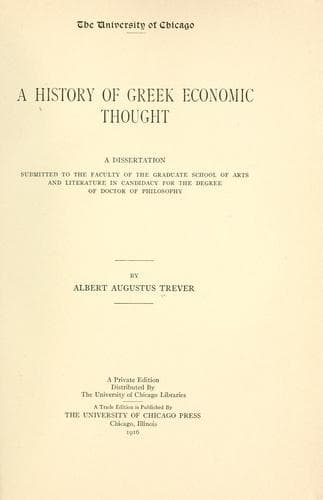
A History of Greek Economic ThoughtTrever, Albert Augustus
History
A History of Greek Economic Thought
Trever, Albert Augustus
Economics -- Greece -- History; Thesis (Ph. D.)
II. ECONOMIC IDEAS BEFORE PLATO, AND REASONS FOR THE UNDEVELOPED
CHARACTER OF GREEK ECONOMICS 14
III. PLATO 22
1. General standpoint.
2. Theory of value.
3. Wealth: theory; moral attitude.
4. Production.
_a_) Agriculture.
_b_) Capital.
_c_) Labor and industry:
(1) Plato’s attitude toward.
(2) Division of labor.
(3) Slavery.
5. Money: theory; moral attitude; interest.
6. Exchange: theory; criticism of Plato’s negative attitude.
7. Population.
8. Distribution: theory; attitude toward laboring classes.
9. Communistic and socialistic ideas.
_a_) Reasons for such tendencies in Greek thought.
_b_) _Republics_ before Plato: Hippodamas; Phaleas.
_c_) Plato’s _Republic_.
_d_) Plato’s _Laws_.
IV. XENOPHON 63
1. Double standpoint.
2. Theory of value.
3. Wealth: practical interest in.
4. Production.
_a_) Theory; positive interest.
_b_) Agriculture.
_c_) Capital.
_d_) Labor and industry.
(1) Positive interest in its development.
(2) Division of labor.
(3) Slavery.
5. Money: theory; in favor of unlimited increase.
6. Exchange: proposed means for its free development.
7. Population.
8. Distribution: attitude toward masses.
9. Socialistic tendencies in the _Revenues_.
V. THE ORATORS—DEMOSTHENES, ISOCRATES 77
VI. ARISTOTLE 81
1. Attitude toward matters economic; domestic and public economy.
2. Theory of value.
3. Wealth: theory; negative attitude toward.
4. Production: theory; negative standpoint.
_a_) Agriculture.
_b_) Capital: theory; negative interest.
_c_) Labor and industry.
(1) Negative attitude.
(2) Division of labor.
(3) Slavery.
5. Money: origin; theory; interest; reasons for the negative
attitude of Aristotle and other Greek philosophers.
6. Exchange: theory; tariff; criticism of “chrematistik.”
7. Population.
8. Distribution: theory; attitude toward masses.
9. Communism and socialism.
_a_) Negative criticism of Plato’s _Republic_ and other systems.
_b_) Positive theory.
VII. MINOR PHILOSOPHERS, CONTEMPORARIES OR SUCCESSORS OR PLATO AND
ARISTOTLE 125
1. The Academy, Speusippus, Xenocrates, Crantor.
2. Theophrastus.
3. _Economica_; the pseudo-Aristotelian _Economica_.
4. Cyrenaics: Aristippus; Bion.
5. Epicureans.
6. Cynics: Antisthenes; Diogenes; Crates.
7. Pseudo-Platonic _Eryxias_.
8. Teles.
9. Stoics: Zeno; Aristo; Cleanthes; Chrysippus; Plutarch.
10. Communistic tendencies after Aristotle.
VIII. GENERAL CONCLUSIONS ON THE IMPORTANCE AND INFLUENCE OR GREEK
ECONOMICS 146
BIBLIOGRAPHY 151
INDEX 157
CHAPTER I
INTRODUCTION
Public-domain text, read in full here on John Shaqi.
Reviews
Reviews
No reviews yet
Be the first to share your thoughts on this work.
Join the Discussion
Join the discussion
Sign in to leave a comment or review.
Sign InorCreate an account