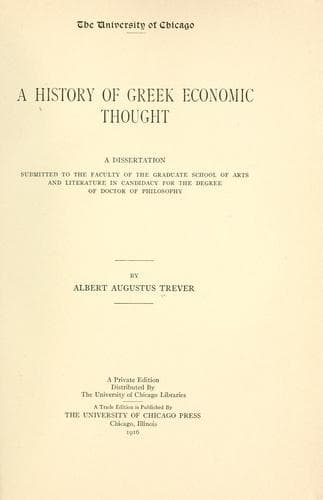
A History of Greek Economic ThoughtTrever, Albert Augustus
History
A History of Greek Economic Thought
Trever, Albert Augustus
Economics -- Greece -- History; Thesis (Ph. D.)
It would take us too far afield to discuss the diverse ways in which
Plato uses his principle. We may observe in passing, however, that
he applies it to war, in his interesting criticism of the
citizen-soldier;[170] to the finer arts, even when they are quite
similar to each other;[171] to politics, as noted above; to justice
and the moral life in general;[172] and to the intellectual life, in
his unsparing criticism of the superficial versatility and
dilettantism of the contemporary Athenian democracy, which trusts
the government to any incompetent, professes to be able to imitate
everything, and makes the many-sided Sophist (πολλαπλοῦς) the man of
the hour.[173] Though he begins with the development of the
principle as an economic fact, his primary interest in it is as a
moral and intellectual maxim. The fact that the cobbler sticks to
his last is only a symbol (εἴδωλον) of justice.[174] Nevertheless
Plato does appreciate to a remarkable degree the economic bearings
of the law, and his discussion of it is notably scientific and
complete.[175] He sometimes pushes its application to an extreme,
though such instances are perhaps meant in a playful Socratic
vein.[176] At least, like Ruskin, he understands that extreme
specialization must produce narrow and one-sided men, and that
progress revolts against its too rigid application.[177] He is aware
too that the division of labor breaks down in the case of the poor
unemployed of the state, since they have no special work.[178]
SLAVERY
Plato is not blind to the ethical aspects of the problem of slavery. In
his first healthy state (ὑγιείνη), slavery and war are conspicuously
absent, and it is the natural inference that the author believed these
to be necessary evils of the more complex state.[179] He appreciates the
dangers of absolute power, even in private life, and believes that few
men can stand the strain.[180] He conceives human nature as a unity that
defies absolute division into separate classes.[181] Though he does not
renounce slavery in the _Republic_, he would limit, it to the barbarians
and to those who seem unfit for the higher life.[182] It plays a
remarkably small part in his first state, and it would seem that his
idealism is here struggling against what he feels to be an economic
necessity. In the _Laws_, he frankly accepts the necessity, and puts
even agriculture, as well as the other industries, into the hands of
slaves.[183] However, they are not to be treated as animals, but as
rational men, in whom a proper usage may develop a certain degree of
morality and ambition for good work.[184] To be sure, his purpose is
economic rather than ethical—to make the slaves satisfied with their
lot, and thus better producers.[185] He makes no mention of freedom as a
reward for good behavior, though he elsewhere provides for the existence
of freedmen in the state, and stipulates that they shall not become
richer than their former masters.[186]
Public-domain text, read in full here on John Shaqi.
Reviews
Reviews
No reviews yet
Be the first to share your thoughts on this work.
Join the Discussion
Join the discussion
Sign in to leave a comment or review.
Sign InorCreate an account