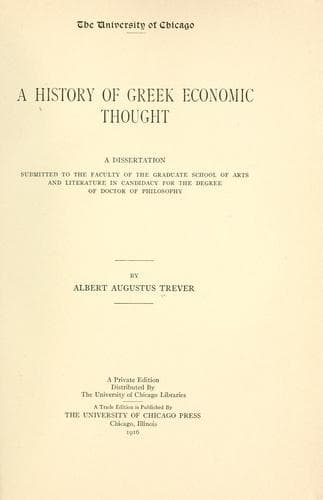
A History of Greek Economic ThoughtTrever, Albert Augustus
History
A History of Greek Economic Thought
Trever, Albert Augustus
Economics -- Greece -- History; Thesis (Ph. D.)
The sweeping assertion is too often made that the Greek people were
hostile to trade, and therefore that their theorists were especially
opposed to it. We have already seen how false this idea is for the
Greeks themselves,[215] but it also needs a great deal of qualification
in the case of their writers. Their hostility is directed especially
against the more petty business of retail trade (καπηλική) rather than
against the extensive operations of the merchant (ἔμπορος). But their
opposition even to this is not entirely undiscriminating. We have seen
that Plato clearly understands the necessity of exchange to the life of
the state.[216] He admits that even retail trade is not necessarily
evil.[217] The chief reason why it appears so is because it gives free
opportunity for the vulgar greed of unlimited gain, which is innate in
man.[218] If the noblest citizens, who are governed by rational
interests, should become retailers and innkeepers, the business would
soon be held in honor.[219]
Plato, however, would limit exchange to its primary function as defined
above.[220] Like Ruskin, he believes that, whenever it is pursued merely
for private gain, it becomes a source of degeneration to individual and
state. It is then akin to the fraudulent or counterfeit pursuits
(κιβδήλοις).[221] The retailers in well-ordered states are generally the
weakest men, who are unable to undertake other work.[222] The rulers in
the _Republic_ must keep themselves entirely free from the trammels of
trade, lest they become wolves instead of shepherds,[223] though Plato
is grappling here with a very real problem that still faces us—how to
prevent graft among public servants.[224] In the _Laws_, retail trade is
entirely prohibited to citizens,[225] and permitted only to metics and
strangers,[226] and, indeed, only to those whose corruption will be of
least injury to the state.[227] These aliens are not to be permitted to
gain overmuch wealth,[228] and they must depart from the state, after
twenty years’ residence, with all their belongings.[229] Retail trade,
even in their hands, must be strictly limited to the demands of the
state,[230] and confined to the market-place for the sake of
publicity.[231] All exchange must be honest, dealing with unadulterated
products (ἀκίβδηλον).[232] There shall be no dickering over sales, but
only one price shall be set upon goods each day. If this is not
accepted, the goods must be removed from sale until the following
day.[233] If possible, the executors of the laws should try to fix a
just schedule of prices, to allow of moderate gain, and should see that
this is observed by the retailers.[234] As a climax to all these
precautions, Plato would have the rulers take pains to devise means
whereby the retailers shall not degenerate into unbridled shamelessness
and meanness of soul.[235] Under such limitations, he has faint hopes
that retail trade may be freed of its stigma, so as to do least harm to
Public-domain text, read in full here on John Shaqi.
Reviews
Reviews
No reviews yet
Be the first to share your thoughts on this work.
Join the Discussion
Join the discussion
Sign in to leave a comment or review.
Sign InorCreate an account