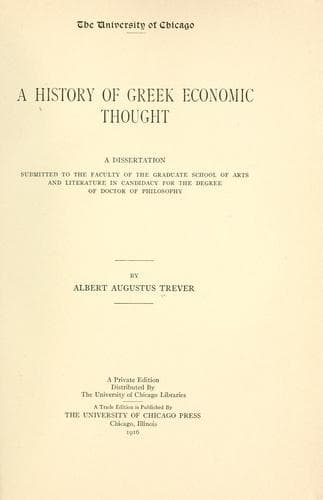
A History of Greek Economic ThoughtTrever, Albert Augustus
History
A History of Greek Economic Thought
Trever, Albert Augustus
Economics -- Greece -- History; Thesis (Ph. D.)
_Pol._ 281D-E; cf. also _Phaedo_ 99A-B; _Phileb._ 27A; _Timaeus_
46C-D.
Footnote 114:
_Sophist._ 219A-D. Bonar’s (_op. cit._, p. 20) criticism of this on
the ground that learning may produce something new, while the arts may
merely change the shape of things, takes Plato too seriously. We have
here only a characteristic Platonic generalization. Cf. Shorey, _Unity
of Plato’s Thought_ (1903), p. 64, n. 500, on the foregoing passages
from _Sophist._ and _Pol._; cf. Robin, _op. cit._, pp. 231 f.
Footnote 115:
_Rep._ 371C.
Footnote 116:
_Laws_ 918B-C, especially πῶς γὰρ οὐκ εὐεργέτης πᾶς ὃς ἂν οὐσίαν
χρημάτων ὡντινωνοῦν, ἀσύμμετρον οὔσαν καὶ ἀνώμαλον, ὁμαλήν τε καὶ
σύμμετρον ἀπεργάζεται.
Footnote 117:
Cf. DuBois, _Precis de l’histoire des doctrines économiques dans leurs
rapports avec les faits et avec les institutions_, pp. 45-47,
comparing Plato and Aristotle on this point. _Laws_ 743D and Plato’s
attitude on agriculture (cf. _infra_) might seem to point the other
way. Cf. _infra_, p. 41, nn. 7-10. Espinas (_Revue des études
Grecques_, XXVII [1914], 247, n. 1) is extreme in calling him a
physiocrat. The term would more nearly apply to Aristotle.
Footnote 118:
Ar. (_Pol._ vi [iv]. 1291_a_12-19) so interprets him, because he finds
the origin of the state in physical needs (_Rep._ 369C ff.), but this
is a carping criticism. Blanqui is hardly fair to Plato on this point
(_Histoire de l’économie politique en Europe_, p. 88). Cf. above, p.
22, n. 4, on Plato’s other theory of origins.
Footnote 119:
_Pol._ 279C.
Footnote 120:
Cf. _infra_ and Poehlmann, _op. cit._, I, 574.
Footnote 121:
As we shall see, the third reason has been exaggerated for the
philosophers. On the favorable attitude to labor at Athens, cf. V.
Brants, _Revue de l’instruction publique in Belg._, XXVI (1883), 108
f., 100 f.; he distinguishes between the _doctrine philosophique_ and
the _doctrine politique_. So also Guiraud, _La main-d’œuvre
industrielle dans l’ancienne Grèce_ (1900), pp. 36-50; Zimmern, _op.
cit._, pp. 382 ff., 256-72. For the older view of general prejudice
against free labor in Greece, cf. Drumann, _Arbeiter und Communisten
in Griechenland u. Rom_ (1860), pp. 24 ff. Francotte (_L’Industrie_)
takes the more conservative position. Cf. _infra_ for further notice
of this problem.
Footnote 122:
Hesiod _Erga_; _Theog._ 969-975, though even here it is opposed to
commerce.
Footnote 123:
_Laws_ 743D, but he would even limit this, so that it may not become a
sordid occupation.
Footnote 124:
_Laws_ 760E-761C, 763D. Ruskin cites this in _Fors Clav._; cf. Vol.
XXIX, 546.
Footnote 125:
Cf. pp. 19 f., and notes; cf. also p. 106, n. 1. The extensive
commerce of Athens necessitated the presence of a comparatively large
amount of money capital, and a large amount was also invested in
slaves. For further notice, cf. _infra_, p. 68, nn. 8 ff., on the
terms.
Public-domain text, read in full here on John Shaqi.
Reviews
Reviews
No reviews yet
Be the first to share your thoughts on this work.
Elsewhere in the archive
Join the Discussion
Join the discussion
Sign in to leave a comment or review.
Sign InorCreate an account