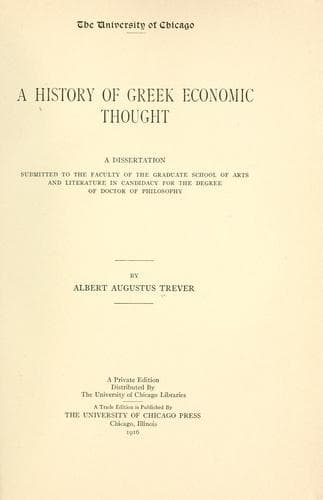
A History of Greek Economic ThoughtTrever, Albert Augustus
History
A History of Greek Economic Thought
Trever, Albert Augustus
Economics -- Greece -- History; Thesis (Ph. D.)
3. _Confusion of economics with ethics and politics._—The assertion that
Greek economic theory was confounded with ethics and politics has become
a commonplace. The economic ideas of Greek thinkers were not arrived at
as a result of a purposeful study of the problems of material wealth.
All economic relations were considered primarily from the standpoint of
ethics and state welfare. “The citizen was not regarded as a producer,
but only as a possessor of wealth.”[8] Such statements are too commonly
accepted as a final criticism of Greek thinkers. Though the confusion
was a source of error, and caused Greek economic thought to be one-sided
and incomplete, yet some important considerations should be noted.
_a_) The Socratic philosophers are our chief source for the economic
ideas of the Greeks. Too sweeping conclusions should not, therefore, be
drawn from them as to the general attitude of the Greeks. Xenophon is
much freer from the ethical emphasis than the other Socratics.
Thucydides is entirely free from it, and very probably his standpoint
came much nearer being that of the average Athenian citizen.
_b_) The confusion was not merely with individual ethics, for Greek
moral philosophy always had the welfare of the state for its goal.
Indeed, the basal reason for this close union of economics, ethics, and
politics is the true idea that the state should rise above internal
strife, and unite all in a care for the common interest.[9]
_c_) The standpoint of the Greek philosophers is certainly no more to be
criticized than is that of the so-called orthodox political economy.[10]
They represent two extremes. If the Greek theory did not give to wealth
its full right, and was open to the charge of sentimentalism, the
Ricardian doctrine, with its “economic man,” which eliminated all other
ideals and impulses, was an unreal and pernicious abstraction. Of the
two errors, the Greek is the less objectionable, and is more in accord
with the trend of economic thought today. The best economists are now
insisting more and more on the Greek idea that economic problems must be
considered from the standpoint of the whole man as a citizen in society.
Modern political economy “has placed man as man and not wealth in the
foreground, and subordinated everything to his true welfare.” “Love,
generosity, nobility of character, self-sacrifice, and all that is best
and truest in our nature have their place in economic life.”[11] “The
science which deals with wealth, so far from being a ‘gospel of Mammon,’
necessarily begins and ends in the study of man.”[12] “Es soll kein
Widerspruch zwischen Ethik und Volkswirtschaft bestehen, es soll das
Sittengesetz für die Wirtschaft gelten und in ihr ausgeführt
werden.”[13] Such strong statements taken at random from modern
economists should serve to temper our criticism of the Greek confusion.
Plato’s definition of economics, as suggested by one of the most recent
Public-domain text, read in full here on John Shaqi.
Reviews
Reviews
No reviews yet
Be the first to share your thoughts on this work.
Join the Discussion
Join the discussion
Sign in to leave a comment or review.
Sign InorCreate an account