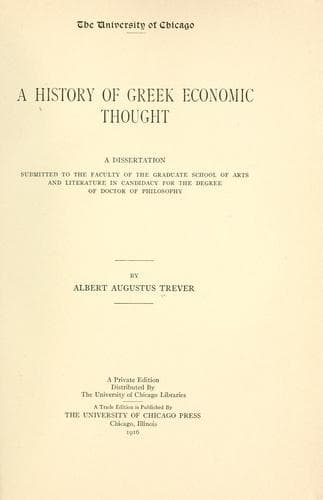
A History of Greek Economic ThoughtTrever, Albert Augustus
History
A History of Greek Economic Thought
Trever, Albert Augustus
Economics -- Greece -- History; Thesis (Ph. D.)
The passages above cited, n. 1 above, need not imply labor for
capitalists. It does not appear that there was ever a considerable
body of free citizen laborers at Athens, who worked for capitalists,
though the number of free workers, aside from labor on the farms, was
fairly large. Cf. _C.I.A._ for records of such labor on the buildings
of the acropolis; Boeckh, _op. cit._, I, 58: “Der geringere war durch
seine Umstände so gut als der arme Schutzverwandte oder Sklave zur
Handarbeit genöthigt.” On the favorable attitude toward free labor at
Athens, cf. above, p. 29, n. 4. Poehlmann (_op. cit._, _in loc._)
takes the opposite view as to the number of free laborers for
capitalists.
Footnote 255:
_Rep._ 552B-D, a characteristic passage; _Gorg._ 507E; _Laws_ 757B.
Footnote 256:
920C.
Footnote 257:
740B ff., 923; but his purpose is to keep the allotments intact.
Footnote 258:
847B: μισθῶν δὲ αὐτοῖς περὶ καὶ τῶν ἀναιρέσεων τῶν ἔργων, καὶ ἐάν τις
αὐτοὺς ἕτερος ἢ κεῖνοί τινα ἄλλον ἀδικῶσι, μέχρι δραχμῶν πεντήκοντα
ἀστυνόμοι διαδικαζόντων, etc.; perhaps a strained interpretation.
Footnote 259:
On his attitude to industry, cf. pp. 32 ff.
Footnote 260:
Bonar, _op. cit._, p. 29.
Footnote 261:
Bussy, _Histoire et Réfutation du Socialisme_ (1859), p. 119.
Footnote 262:
Oncken, _op. cit._, p. 34.
Footnote 263:
Haney, _op. cit._, p. 16.
Footnote 264:
Zeller, _Phil. Gr._, II, 1 (1889), 907; cf. also above, pp. 32 f.
Historians of economic thought generally state the case extremely;
e.g., Kautz, _op. cit._, p. 59; Blanqui, _op. cit._, p. 45; Souchon
also, to some extent. Poehlmann (_op. cit._, II, 36-108) errs in the
opposite way.
Footnote 265:
Pol. ii. 5. 1264_a_11-17, 36-38; 1264_b_11-13.
Footnote 266:
423D: ὡς δόξειεν ἄντις; also 425D, both cited by Poehlmann.
Footnote 267:
415E-417B, 420A-421C admit of no other interpretation. Cf. 421C, how
he turns to the next related point (τοῦ τούτου ἀδελφόν) the question
of the effect of wealth or poverty on the artisans (τοὺς ἄλλους
δημιουργούς). Cf. also _infra_ for other citations.
Footnote 268:
_Pol._ 1264_a_36-38, repeated by many moderns.
Footnote 269:
_Rep._ 415B-C.
Footnote 270:
Cf. the undiscriminating statement of Souchon, _op. cit._, p. 41: “Et
il n’y a guère eu, au cours de l’histoire de la science politique, de
conception plus aristocratique que le mythe fameux des trois races
d’or, d’argent et d’airain.”
Footnote 271:
_Pol._ 1264_b_15-25, repeated by Grote and others.
Footnote 272:
_Rep._ iv. beg.-421C.
Footnote 273:
I Cor. 12:14 ff.; for other evidence of Plato’s interest in all
classes, cf. 519E ff., and the entire argument against Thrasymachus,
Book I.
Footnote 274:
Public-domain text, read in full here on John Shaqi.
Reviews
Reviews
No reviews yet
Be the first to share your thoughts on this work.
Elsewhere in the archive
Join the Discussion
Join the discussion
Sign in to leave a comment or review.
Sign InorCreate an account