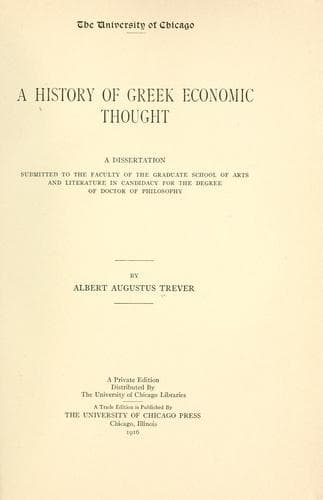
A History of Greek Economic ThoughtTrever, Albert Augustus
History
A History of Greek Economic Thought
Trever, Albert Augustus
Economics -- Greece -- History; Thesis (Ph. D.)
_Rep._ 421A, cited by Zeller, _op. cit._, II, 1, 907, as evidence of
this, states merely that it is more important that there be efficient
rulers than efficient cobblers. Cf. Poehlmann, _op. cit._, II, 36-108,
a masterly defense of the _Republic_ on this point, criticizing both
Zeller and Gomperz. He errs on the other side, however, as e.g., p.
96, where he infers from _Rep._ 462C that Plato intended his communism
to apply to the whole people.
Footnote 275:
416A-B, 417B.
Footnote 276:
415A, introducing the alleged aristocratic myth.
Footnote 277:
463B, 417B, 416A, 547C.
Footnote 278:
431E-432A, 443E, 423D.
Footnote 279:
421C-E, cited on p. 48, n. 8. Cf. Poehlmann, _op. cit._, II, 91.
Footnote 280:
590C.
Footnote 281:
431D-E, 434C.
Footnote 282:
378B, E, 377B, insisting upon proper stories for all children;
915E-520A, implying that the artisans shall share in all benefits of
the state up to their capacity.
Footnote 283:
643B-C.
Footnote 284:
847B, 921C-D.
Footnote 285:
936B-C.
Footnote 286:
Mill is an exception, but despite his thoroughgoing definitions of
economics.
Footnote 287:
Cf. Ar. _Pol._ ii. 1266_b_17-24.
Footnote 288:
On the Spartan system, cf. Guiraud, _La Prop. fonc._, pp. 41 f.;
Poehlmann, _op. cit._, I, 75-98, both of whom oppose the more extreme
theory of communism in Sparta.
Footnote 289:
On this general subject, cf. Guiraud, _La Prop. fonc._, 573 f.; cf. S.
Cognetti de Martiis, _Socialismo Antico_ (1889), pp. 515-17, on
socialistic tendencies in Greek constitutions and politics.
Footnote 290:
E.g., Esmein, _Nouvelle Revue historique_, 1890, pp. 821 ff. For a
refutation, cf. Poehlmann, _op. cit._, 1st ed., pp. 20 ff.; Guiraud,
_op. cit._, p. 37; Souchon, _op. cit._, pp. 135 f.
Footnote 291:
For a refutation of the common error, cf. Zeller, _op. cit._, I, 1,
317, n. 1, and 318, n. 2; Guiraud, _op. cit._, pp. 574 f. and 7-11;
Souchon, _op. cit._, pp. 136-39 and notes. The earliest witnesses for
Pythagorean communism, Epicurus, in Diog. L. x. 2, and Timaeus of
Tauromenium, _ibid._, viii. 10 are remote from his time and
untrustworthy. The later writers (Diog. L. viii. 10; Aul. Gell. i. 9.
12; Hippolytus _Refut._ i. 2. 12; Porphyry _Vit. Pyth._ 20; Jamblichus
_De Pyth. vit._ 30, 72, 168, 257, etc.; Photius, under κοινά) quoted,
and made the tradition general. The older writers know nothing of the
tradition. Moreover, some passages give evidence of private property
among the Pythagoreans (Diog. L. viii. 1. 15, 39). The origin of the
tradition has been plausibly assigned to a misunderstanding of the
proverb κοινὰ τὰ τῶν φίλων and to the doctrine of moral helpfulness
among the Pythagoreans. S. Cognetti de Martiis (_op. cit._, pp.
459ff.) calls it _socialismo cenobito_.
Footnote 292:
Public-domain text, read in full here on John Shaqi.
Reviews
Reviews
No reviews yet
Be the first to share your thoughts on this work.
Elsewhere in the archive
Join the Discussion
Join the discussion
Sign in to leave a comment or review.
Sign InorCreate an account