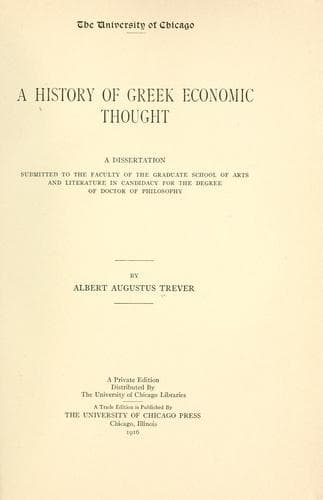
A History of Greek Economic ThoughtTrever, Albert Augustus
History
A History of Greek Economic Thought
Trever, Albert Augustus
Economics -- Greece -- History; Thesis (Ph. D.)
Cf. pp. 48 f. and notes. Even Aristotle admits (1264_a_33) that Plato
makes his husbandmen absolute owners of their lots, on condition of
paying rental. The rulers alone (μόνοις) are to keep themselves from
silver or gold (417A). Cf. Book IV, beg.: οἶον ἄλλοι ἄγρούς τε
κεκτημένοι καὶ οἰκίας οἰκοδομούμενοι, etc.; 420A, 416D-E, 458C,
464B-D, where the community is applied to the guards only, and 464A-D,
where the same is true of family communism. Doubtless he would have
extended it farther, had he thought it feasible (462B-C), but
Poehlmann (_op. cit._, I, 569 f.; II, 96 f.) overemphasizes this
demand of Plato. Adler (_Geschichte des Socialismus und Kommunismus
von Plato bis zur Gegenwart_, p. 44), DuBois (_op. cit._, p. 40),
Oncken (_op. cit._, p. 34), Souchon (_op. cit._, 148); Malon (_op.
cit._, pp. 90 f.), Shorey (_Class. Phil._, October, 1914, art. on
“Plato’s Laws”) all agree with the foregoing conclusion. Francotte
(_L’Industrie_, II, 258 ff.) leaves the question open, but (261 f.)
observes that the third class is at least restrained from extremes of
wealth and poverty.
Footnote 312:
421D, 421E-422E.
Footnote 313:
_Ibid._, the fundamental idea of the _Republic_. L. Stein (_Sociale
Frage_, p. 164) rightly says: “Denn der Kommunismus Platons ist seinem
Schoepfer nicht Zweck, sondern blosses paedagogisches Mittel.”
Footnote 314:
415E-416A, 417B, 420D, 421A, 421C. He would also avoid vulgarization
of the rulers through trade (416E-417A).
Footnote 315:
421D.
Footnote 316:
Ruskin thinks that inequality of possessions, in itself, does not
necessarily mean either evil or good for a nation (_Unto This Last_,
II, 31 [Vol. XVII, 46 f.]); he argues that each is born with an
absolutely limited capacity, and calls the idea of natural equality of
men “radical blockheadism” (_Fors Clav._, VIII, Letter 95, 6 [Vol.
XXIX, 496]); cf. _Unto This Last_, III, 54 (Vol. XVII, 74); _Modern
Painters_, III, Pt. IV, chap. x, 22 (Vol. III, 189); _Seven Lamps of
Architecture_, IV, 28 (Vol. VIII, 167); _Fors Clav._, II, Letter 14, 4
and note (Vol. XXVII, 248); _Stones of Venice_, III, 4 (Vol. XI, 260),
all of which emphasize its impossibility. He strongly opposes
socialism, cf. above, and _Mun. Pul._, 21 (Vol. XVII, 144), though his
economic ideas contained essentially the germ of modern socialistic
doctrine.
Footnote 317:
Cf. his ironical criticism of democratic equality in Athens, 558C:
ἰσότητά τινα ὁμοίως ἴσοις τε καὶ ἀνίσοις διανέμουσα; _Laws_ 757B-D,
744B-C; cf. _infra_ for Aristotle’s idea. Cf. p. 61, n. 1 for further
notice of these passages.
Footnote 318:
Public-domain text, read in full here on John Shaqi.
Reviews
Reviews
No reviews yet
Be the first to share your thoughts on this work.
Elsewhere in the archive
Join the Discussion
Join the discussion
Sign in to leave a comment or review.
Sign InorCreate an account