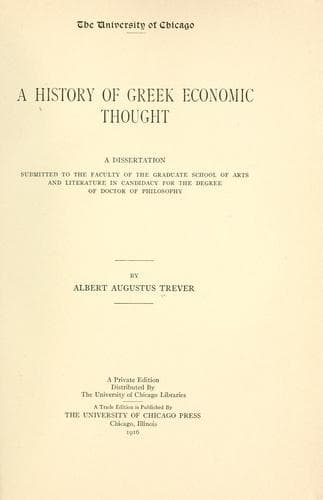
A History of Greek Economic ThoughtTrever, Albert Augustus
History
A History of Greek Economic Thought
Trever, Albert Augustus
Economics -- Greece -- History; Thesis (Ph. D.)
As seen above, special emphasis was laid by Xenophon upon natural
resources as an element in production, both in land and in the mines.
His great interest in and eulogy of agriculture as the basal industry,
upon which all other sources of wealth depend,[409] have caused him to
be classed with the physiocrats of modern time but such an
interpretation is hardly warranted. Without doubt, agriculture is, in
his opinion, the supremely honorable occupation. It shares with war the
right to be placed above all other vocations.[410] It permits the
maximum of leisure and physical development, and is not unworthy of the
personal attention of a prince.[411] It is the most pleasant, most
productive,, most dignified, of callings; the best exercise for the
athlete, the finest school for education in patriotism and justice, and
it offers the greatest opportunity for the exercise of hospitality to
men and reverence to gods.[412] Indeed, it is the first of all
occupations for an honorable and high-minded man to choose.[413] Here we
have the highest eulogy of agriculture in Greek literature. It is in
essence a sound statement, and offers a needed message for today.
Though Xenophon recognized the practical importance of capital in
industrial enterprises,[414] he developed no theory of it in his
writings. He appreciated, however, the value of being able to keep a
surplus.[415] The term ἀφορμή, as used by him of the provision of raw
material for weaving, probably signified nothing more than it would have
done to any Athenian business man of his time.[416] The word originally
meant a “starting-point,” especially in war.[417] Later, it signified
the “means” or “resources” with which one begins a project,[418]
especially in business. It was an easy step from this general business
use to the meaning, “financial capital” of a banker.[419] Other terms
for capital were ἐνεργά, used of interest-bearing capital in antithesis
to ἀργά, of goods merely for use;[420] κάρπιμα, “goods that yield a
produce,” as opposed to ἀπολαυστικά, “goods to be enjoyed,”[421] which
is suggestive of Mill’s[422] definition, “that part of his possessions
... which he designs to employ in carrying on fresh production,” and of
his two kinds of capital, “circulating” and “fixed”; ποιητικά, “things
for further production,” as opposed to πρακτικά, “things merely for
use”;[423] κεφάλαιος, of capital as opposed to interest or income.[424]
The term ἔρανος, also, since it came to mean a “contribution of money,”
was often used of a loan, and therefore approached the signification of
“money capital.”[425]
Public-domain text, read in full here on John Shaqi.
Reviews
Reviews
No reviews yet
Be the first to share your thoughts on this work.
Elsewhere in the archive
Join the Discussion
Join the discussion
Sign in to leave a comment or review.
Sign InorCreate an account