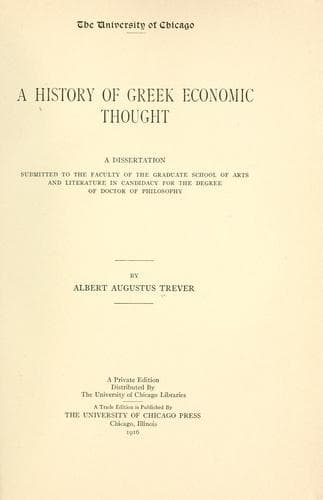
A History of Greek Economic ThoughtTrever, Albert Augustus
History
A History of Greek Economic Thought
Trever, Albert Augustus
Economics -- Greece -- History; Thesis (Ph. D.)
The Greeks had no specific word for production, as we have, since
industry, though well developed, was not a dominant feature of Greek
life, and economics had not become a separate science. The word ἐργασία,
meaning “labor” or “business,” served the purpose. The term was used of
productive labor,[395] of building or manufacturing,[396] of work in raw
materials,[397] most commonly of agriculture,[398] of industries in
general,[399] of the trades, commerce, or other business for
money-making,[400] and of a guild of laborers.[401] The term ἡ ποιητικὴ
τέχνη, “the productive art,” which approaches more nearly to a specific,
technical expression, was also used.[402] Thus, though there is no
clear-cut term for production, the statement of Zimmern[403] that the
Greeks had no better word for “business” than ἀσχολία, “lack of
leisure,” is hardly warranted.
Xenophon was far more interested than Plato or Aristotle in the problem
of practical production. His shrewd discussion of agriculture, and his
urgent appeal to Athens to increase her revenues by systematic
exploitation of the mines, and by the encouragement of industry and
commerce, reveal a mind awake to economic advantage. Though at times he
seems almost to make war and agriculture the only true means of
production, it is evident that he has a live interest in all means of
acquisition.[404] Toward the theory of production, however, his
contribution is not large. In the _Economics_, he recognizes the
importance of labor and natural resources in production, and in the
_Revenues_, he sees the necessity of capital.[405] But naturally, like
Aristotle and the southern planter, he confuses capital with labor, in
the person of the slave.[406] The fable of the dog and the sheep reveals
a knowledge of the machinery of production, and some insight into the
proper relation between the employer and the laborer.[407] Xenophon’s
distinct contribution to future economic thought, however, consists in
his appreciation of the fact that economic production has its definite
limits; that the same ratio of profits cannot be increased indefinitely
by the constant addition of more labor and capital, but that these must
be proportioned to the greatest possible return.[408] To be sure, he
does not appreciate the scientific significance of the principle. His
purpose is rather to emphasize the danger of overproduction, and he even
fails to grasp the necessary application of this danger to the silver
mines. However, as the enunciator of the principle, he may be called the
forerunner of the doctrine of diminishing returns.
Public-domain text, read in full here on John Shaqi.
Reviews
Reviews
No reviews yet
Be the first to share your thoughts on this work.
Elsewhere in the archive
Join the Discussion
Join the discussion
Sign in to leave a comment or review.
Sign InorCreate an account