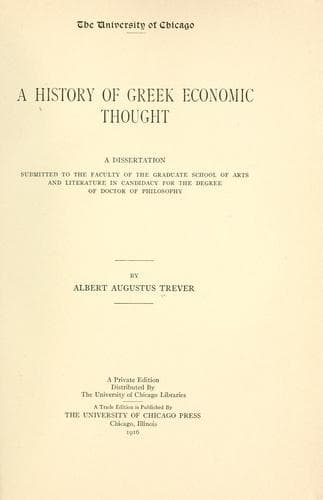
A History of Greek Economic ThoughtTrever, Albert Augustus
History
A History of Greek Economic Thought
Trever, Albert Augustus
Economics -- Greece -- History; Thesis (Ph. D.)
The οἰκονομικός, at least, the first extant, devoted to private
economy, and especially agriculture, but revealing practical interest
in the details of the production of wealth. Cf. _infra_ for further
discussion of _Economica_ in Greek literature.
Footnote 378:
For some qualifications, cf. above, Introduction.
Footnote 379:
_Econ._ i. 2: οἰκονόμου ἀγοθοῦ εἶναι οἰκεῖν τὸν ἑαυτοῦ οἶκον; cf. 3:
τὸν ἄλλου δὲ οἶκον. οἶκον is used of one’s entire property (5).
Footnote 380:
_Mem._ iii. 4. 6; cf. further above, p. 9, n. 4. Cf. Ruskin, _Pol.
Econ. of Art_, I, 12: “Precisely the same laws of economy, which apply
to the cultivation of a farm or an estate, apply to the cultivation of
a province or an island.” Cf. the story in Hdt. v. 29 on this idea.
Espinas (_Revue des Etudes Grecques_, XXVII [1914], 111) contrasts
Xenophon, to whom the royal administration is a greatly expanded
private economy, with Plato’s absorption of all private economy by the
state.
Footnote 381:
_Econ._ i. 7-15; cf. 10: ταύτα ἄρα ὄντα τῷ μὲν ἐπισταμένῳ χρῆσθαι
αὐτῶν ἑκάστοισ χρήματα ἐστι, τῷ δὲ μὴ ἐπισταμένῳ οὐ χρήματα. Cf. p. 23
and notes on Plato and Ruskin. H. Sewall (“Theory of Value before Adam
Smith,” _Publications of the American Economic Association_, II, Part
III, p. 1) says that the conception of value (ἀξία) as a quality
inherent in the thing was not questioned, but Xenophon seems to
question it here. As she observes, n. 1, the term originally meant
“weight,” at first weight in money, as well as actual worth.
Footnote 382:
i. 11 f.
Footnote 383:
_Unto This Last_, beginning; cf. preceding n. 1; Ruskin took _Xen.
Econ._ as the foundation on which he built all his own economic
studies. Cf. _Unto This Last_, Pref., Vol. XVII, pp. xlix and 18; Vol.
XXXI, Introd.; pp. xv ff. It was the first in his _Bib. Pastorum_. Cf.
his Preface to his translation of the _Economicus_; _Arrows of the
Chace_, Vol. XXXIV, 547; _Letters_, II (Vol. XXXVII, 350). In _Mun.
Pul._, IV, 105 (Vol. XVII, 230); also on pp. 288 and 88, he refers to
Xenophon’s “faultless” definition of wealth, citing _Mem._ ii. 3. 7.
Cf. also Vol. XXXI, pp. xvii and 27. Fontpertuis (“Filiation des idées
économiques dans l’antiquité,” _Jour. des écon._, September, 1871, p.
361) thinks this is at bottom the true theory of value.
Footnote 384:
_Econ._ i. 2: ἀποδιδομένοις μὲν οἱ αὐλοὶ χρήματα, μὴ αποδιδομένοις δὲ
ἀλλὰ κεκτημένοις οὔ, τοῖς μὴ ἐπισταμένοις αὐτοῖς χρῆσθαι. Brants
(_Xen. Econ._, p. 8) overemphasizes this.
Footnote 385:
_Rev._ iv. 6-10, a remarkable passage, though he fails to include
silver in the law. Cf. Kautz, _op. cit._, p. 129; Kaulla, _Die
geschichtliche Entwickelung der modernen Werttheorien_, p. 2.
Footnote 386:
Especially in the story of Isomachus (_Econ._), and the _Revenues_.
Footnote 387:
Cf. _infra_; also Espinas, _Histoire des doctrines economiques_, p.
20.
Footnote 388:
Public-domain text, read in full here on John Shaqi.
Reviews
Reviews
No reviews yet
Be the first to share your thoughts on this work.
Elsewhere in the archive
Join the Discussion
Join the discussion
Sign in to leave a comment or review.
Sign InorCreate an account